
Where Cherry Grove Sits Inside North Myrtle Beach
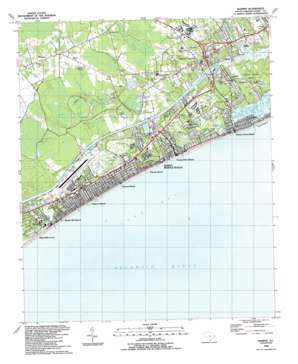
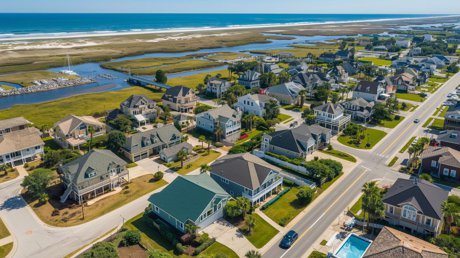
Cherry Grove is the northernmost section of North Myrtle Beach, bordered by Hog Inlet, Dunn Sound, and a network of tidal channels that give many inland lots direct boat access to the Atlantic. The neighborhood’s landmark is the Cherry Grove Fishing Pier, and its defining property type is the channel home with a private dock. That much is uncontested; everything that follows is about what it costs to own one.
Property Types and Price Ranges
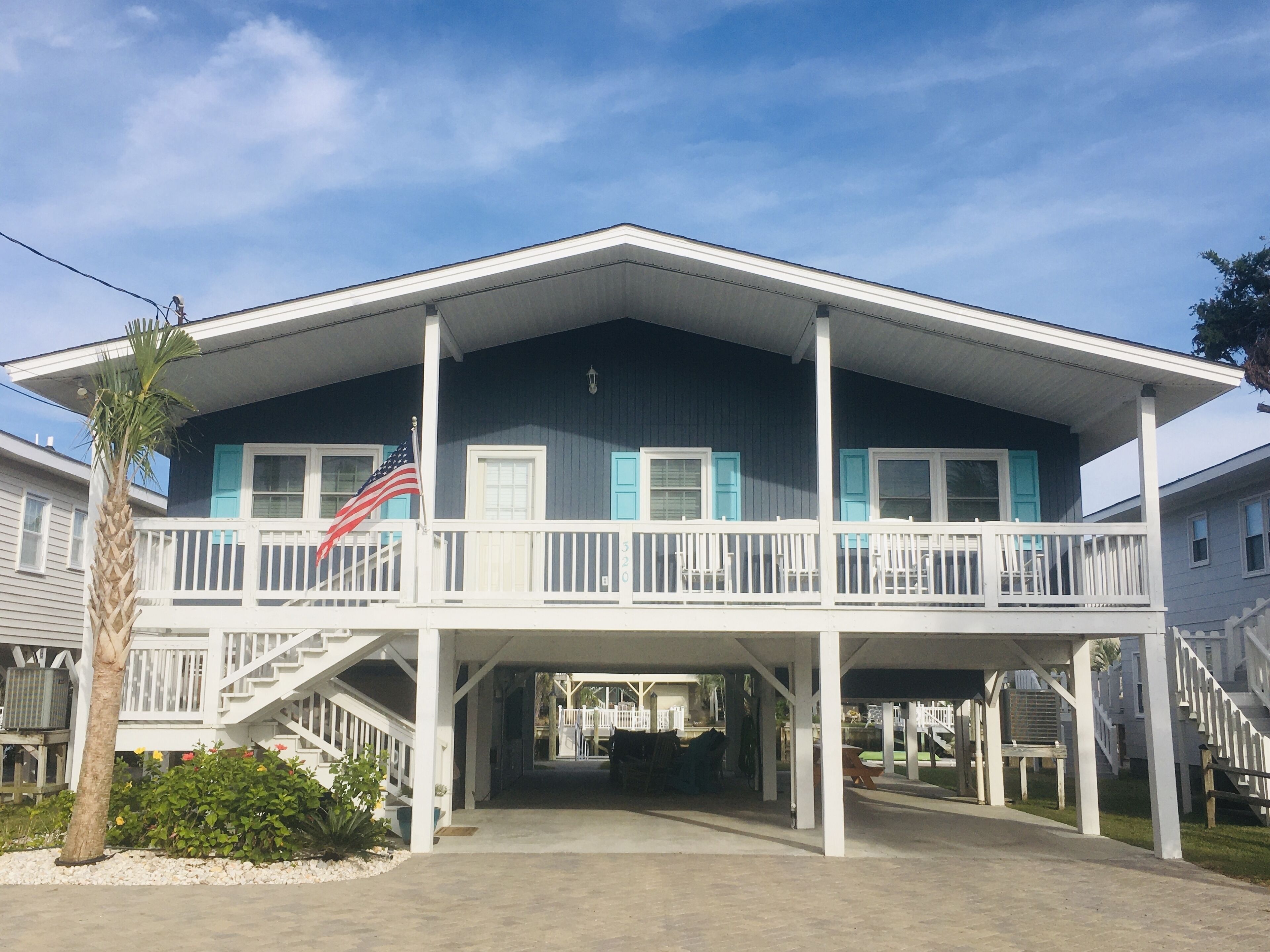
Water access and flood-zone letter move price more than square footage does. A second-row cottage a few hundred feet from a channel home can carry a fraction of the insurance cost for a similar list price.
| Property type | Typical price range | Flood-zone tendency | Notes |
|---|---|---|---|
| Channel home with private dock | $450,000–$1.5M+ | Usually AE, some VE near the inlet mouth | Dock condition and bulkhead age materially affect insurability |
| Oceanfront single-family | $700,000–$2M+ | VE common | Highest insurance cost tier |
| Oceanfront/marsh-view condo | $220,000–$490,000 | AE or VE depending on tower and floor | HOA master policy covers the building; owners still need contents/loss coverage |
| Second-row or inland home | $300,000–$650,000 | Often X, some AE further inland | Lowest flood-cost tier in the neighborhood |
Prince Resort at 3500 N Ocean Boulevard is the concrete example worth knowing: it’s a two-tower condo building standing where the Prince family’s Holiday House Motel once stood beside the pier the same family has owned since 1965. One tower faces the ocean, the other faces the Cherry Grove channel marsh across the street, and current listings span roughly $217,900 for a one-bedroom to the high $300,000s and low $400,000s for two-bedroom oceanfront units, per Century 21 The Harrelson Group’s Prince Resort listings. The building illustrates the point directly: identical square footage commands a real premium for the ocean-facing tower over the marsh-facing one.
What’s the real difference between a channel home and an oceanfront home in Cherry Grove? Beyond view, it’s flood-zone letter and insurance math. Oceanfront lots more often fall in Zone VE, FEMA’s coastal high-hazard designation for wave action, while channel homes set back from the inlet mouth more often fall in Zone AE, a mapped-elevation zone without the wave-action loading. VE-zone construction and insurance requirements are generally the stricter and costlier of the two, even when the sale prices look similar on paper.
The Market Right Now
| Indicator | Cherry Grove Beach | North Myrtle Beach citywide |
|---|---|---|
| Median sale price | $467,000 (3 mo. ending May 2026) | $420,000 |
| Year-over-year change | +8.6% | +4% |
| Median days on market | 109 | 83 |
Cherry Grove Beach is outpacing the citywide median on price growth while taking noticeably longer to sell, according to Redfin’s neighborhood data and Homes.com’s citywide figures. Movoto’s independent tracking of the same neighborhood shows a median list price of $465,000 in June 2026, essentially confirming Redfin’s number from a different data pipeline. That combination, rising price with slower absorption, generally signals a market where sellers still have some pricing power but patient, well-prepared buyers can negotiate on terms.
A median masks dispersion: a $250,000 second-row cottage and a $2 million channel estate can both sell in the same month and both feed into the same $467,000 figure.
Is Cherry Grove’s market cooling right now, or still rising? Both, depending on the metric. Price is still climbing (+8.6% year over year), but the 109-day median time on market is longer than the citywide 83 days, meaning listings are sitting before they sell even as they close higher. That combination favors sellers on price and buyers on negotiating room and timeline.
Flood Zones and Insurance: The Real Numbers
Every general description of Cherry Grove mentions flood risk. Almost none names a zone letter or a dollar figure.
FEMA maps this stretch of coast primarily as Zone AE (a mapped Base Flood Elevation, high risk but without wave-action loading) and Zone VE (coastal high-hazard, wave action, typical along the immediate beachfront of North and Cherry Grove), with Zone X (moderate-to-low risk) further inland, per a 2026 flood-zone guide from a Myrtle Beach-area builder. Separately, Horry County’s hurricane evacuation Zone A, a storm-surge classification that the county tracks independently of FEMA’s flood maps, runs east of House Creek “to the center of Cherry Grove Beach,” according to the county’s Know Your Zone page. Buyers regularly confuse the two systems: a property can sit outside a mapped Special Flood Hazard Area and still fall inside evacuation Zone A.
| Zone | What it means | Typical annual premium | Price effect |
|---|---|---|---|
| VE | Coastal high-hazard, wave action | Often well above the state average; can run into the thousands for older, low-elevation structures | Steepest insurance-driven price discount |
| AE | Mapped Base Flood Elevation, no wave load | Varies widely by elevation relative to BFE | 5–15% below comparable non-flood-zone property |
| X | Moderate/low risk | $350–$1,200 | Minimal, insurance often optional |
South Carolina’s statewide average NFIP premium runs around $798 a year, per Beach Insurance’s 2025 guide, but that average means little for a VE-zone oceanfront buyer to budget against: FEMA’s Risk Rating 2.0 prices each property individually on elevation, foundation type, and distance to water, so a low-elevation VE structure can pay several multiples of the state average. A high-risk-zone quote of $3,351.77 a year for a property with a prior flood loss and a lowest floor several feet below Base Flood Elevation, cited by a South Carolina flood-insurance brokerage, illustrates the ceiling rather than a typical bill. Flood zone designation itself measurably affects resale: AE and VE properties sell for 5% to 15% less than comparable property outside a mapped zone, per a 2026 South Carolina flood-zone explainer.
Condo buyers face a different math. The HOA’s master policy typically covers the building structure, but individual unit owners still commonly carry mid-hundreds to $1,300-plus a year in their own flood coverage, per a South Carolina condo-insurance guide, on top of whatever the HOA assesses for the master policy.
Elevation Certificates Explained
An elevation certificate documents a structure’s lowest floor relative to Base Flood Elevation and is the single document most likely to move a quote up or down. It typically costs $300 to $600 from a licensed surveyor, per the same flood-zone explainer cited above, and the City of North Myrtle Beach’s Planning and Development Department can provide an existing certificate on file for a given address by calling 843-280-5560, according to the city’s Know Your Hazard page. Get one before making an offer, not after closing; it’s the number that determines the premium the buyer will actually pay.
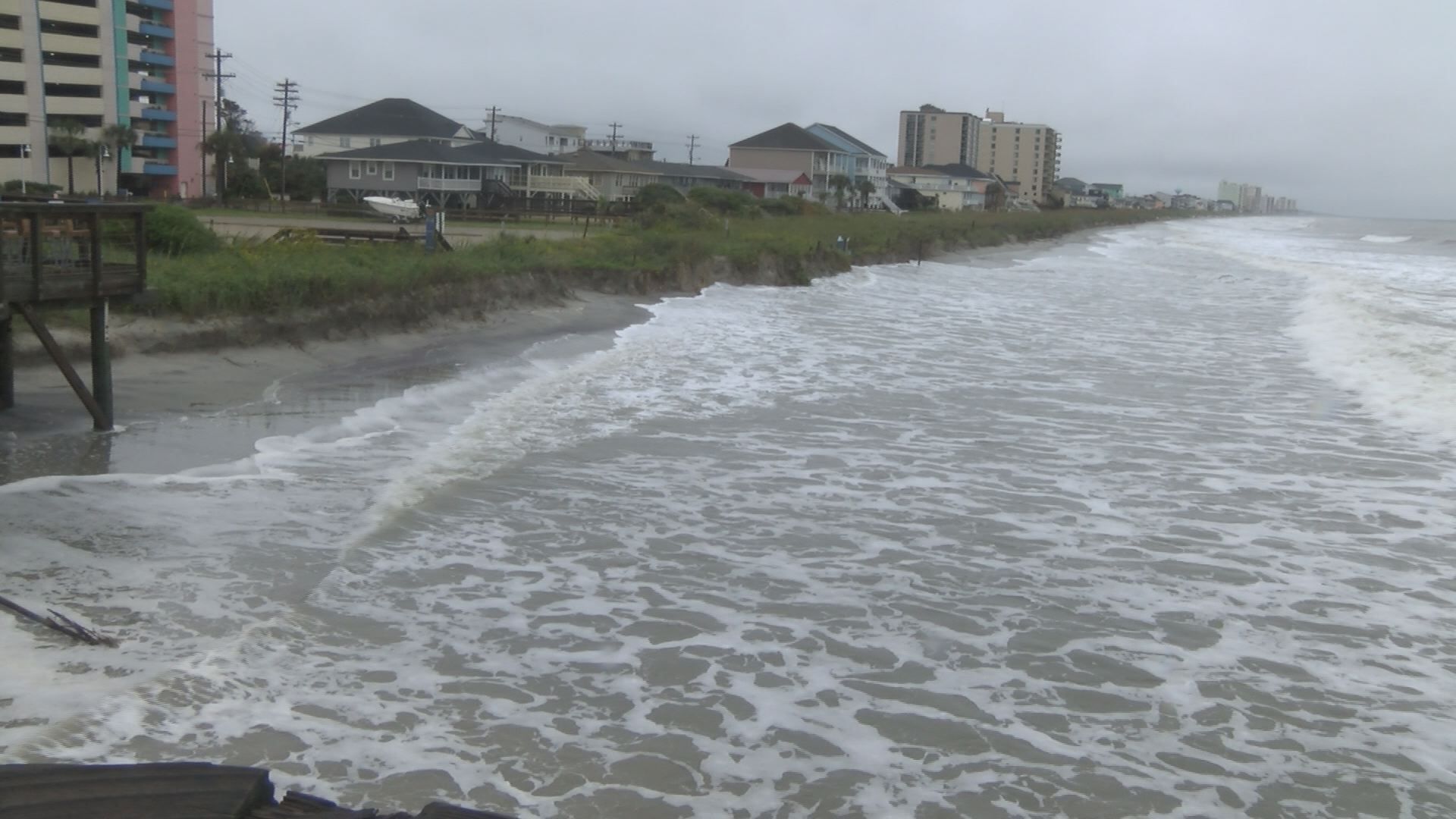
The Cherry Grove Pier itself is the neighborhood’s own flood-risk record. Family-owned since 1965, the 985-foot pier was destroyed by Hurricane Hugo in 1989 and rebuilt with its now-familiar two-story observation deck; Hurricane Floyd snapped that deck off in September 1999 and deposited it 1,000 yards down the beach, and it was rebuilt in time for the next season, according to a documented account from the Prince family. Further back, Hurricane Hazel demolished 75 residences at Cherry Grove Beach specifically in October 1954, per a City of Myrtle Beach historical account. That history is the actual, checkable version of the coastal risk every general guide gestures at without naming a storm or a date.
Do I need flood insurance to buy in Cherry Grove? If the property sits in a mapped Special Flood Hazard Area (most AE and VE parcels do) and the buyer is using a federally backed mortgage, the lender will require it. Outside a mapped zone, it isn’t legally required, but given Cherry Grove’s channel and oceanfront geography, going without it is a real gamble most local agents and insurers advise against.
Buying a Channel Home: Due-Diligence Checklist
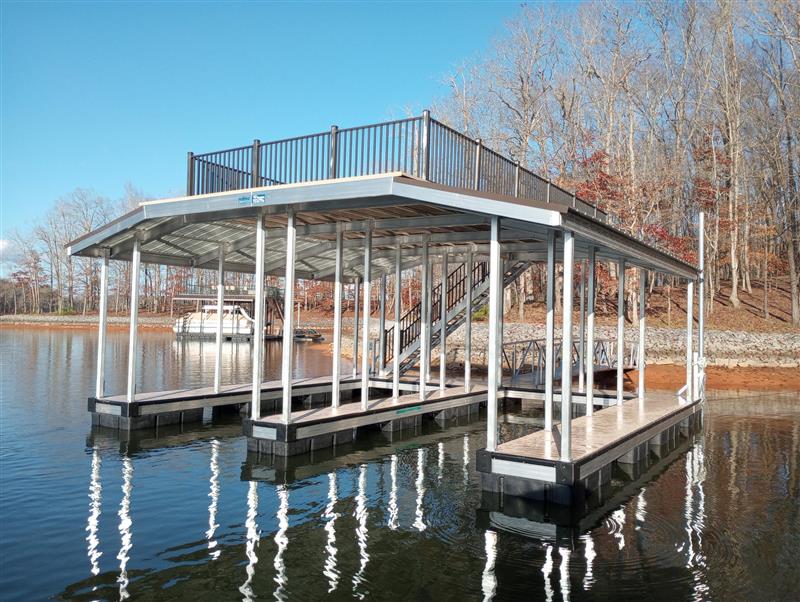
Waterfront doesn’t automatically win. A channel lot with a failing bulkhead or a dock that’s only navigable at high tide can underperform a well-kept second-row property, both on livability and on resale.
- Bulkhead age and condition. Ask for the installation date and any repair history; a failing bulkhead is one of the more expensive surprises a channel-home buyer can inherit.
- Dock permit status. Confirm the dock is permitted, not just present; unpermitted docks can complicate insurance, financing, and resale.
- Tide-dependent navigability. Some channel lots only allow boat access near high tide. Ask specifically whether the dock is usable at low tide for the boat size the buyer actually owns.
- Elevation certificate on file. Request it before making an offer; it’s the number the insurer will price against.
- Flood zone letter, not just “near water.” Confirm AE versus VE directly from the FEMA map, not from a listing description.
Short-Term Rental Income and Regulations

Every general Cherry Grove page treats rental income as a given. The rules that govern it are specific, actively evolving, and worth confirming before assuming any number.
Every short-term rental inside North Myrtle Beach city limits needs an annual business license, and operators must collect and remit accommodations tax to the city, county, and state, per the city’s official STR page. The combined tax load is 13%, made up of a 7% state sales tax and a 6% local accommodations tax, according to a short-term rental regulatory guide. As of the city’s own page, there’s no special zoning or additional permit process beyond that standard licensing, but this is not a settled area: the city has run public workshops on possible new STR restrictions in 2018, 2020, and again through November 2024, January 2025, and two resident/owner information sessions in mid-to-late 2025, with no ordinance adopted as of the most recent information available. A neighboring city, Myrtle Beach, has already moved to restrict STR-to-long-term conversions in some zones, and the same September 2024 study estimated that converting 1,000 short-term units to long-term use would cost combined city, county, and state governments roughly $7.6 million in lost tax revenue, per local reporting on the debate. Buyers underwriting rental income should treat the current rules as the floor, not a fixed ceiling, and check the city’s STR page directly before closing.
Licensing and Tax Registration
New owners need the business license before listing a property, must renew it annually, and are responsible for tax remittance even when a platform like Airbnb or Vrbo collects part of it automatically; the owner remains liable for full compliance regardless of what the platform handles.
Can I legally rent my Cherry Grove home short-term? Yes, under current city rules, provided the business license is obtained and renewed annually and accommodations tax is collected and remitted. Confirm the license and tax status directly with the City of North Myrtle Beach before assuming a purchase’s rental math.
Property Taxes for Owners vs. Investors
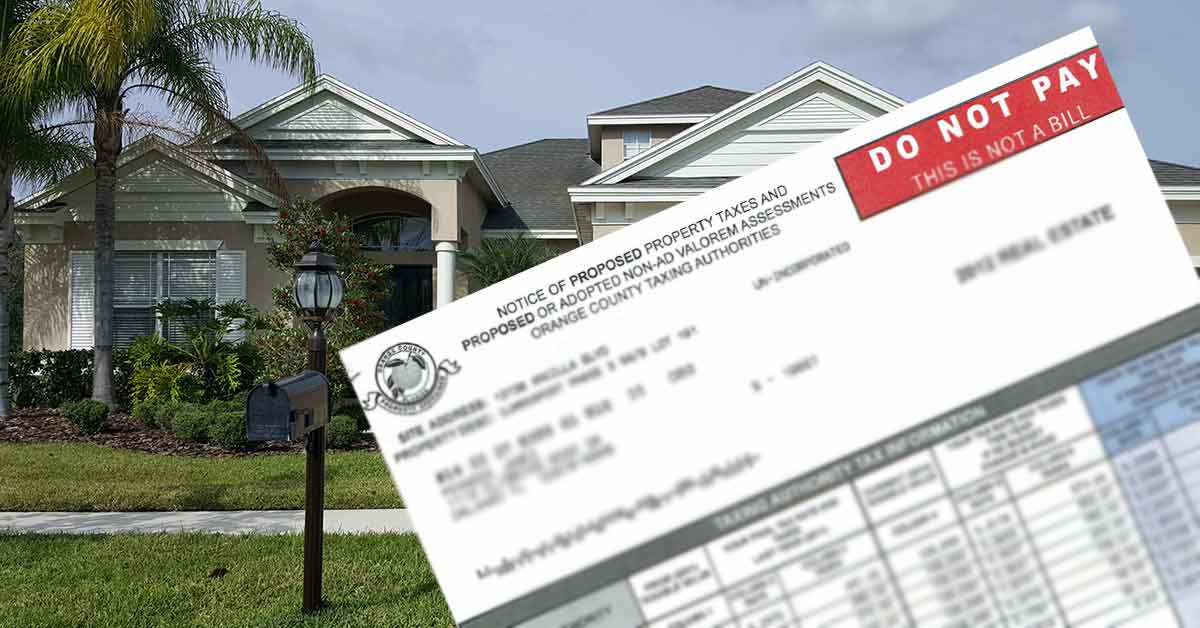
South Carolina taxes real estate on an assessment ratio, not directly on market value, and the ratio depends entirely on how the property is used.
An owner-occupied legal residence is assessed at 4% of fair market value; anything else, second homes, rentals, investment property, is assessed at 6%, per a South Carolina real estate tax guide. The 4% rate isn’t automatic: an owner must apply once with the county assessor’s office and provide proof of legal residence, and failing to file means the county defaults to the 6% rate, according to Horry County’s Guide to Assessment. Legal residence status carries a second, less-discussed benefit: it exempts the property from the school-district operating millage, frequently the single largest line item in the total rate. In one published Horry County example for an unincorporated parcel, the county millage ran 56.2, the school millage 128.1, fire 23.2, and waste management 8.7 for the 2023 tax year, per the county’s own FAQ page, meaning the school-millage exemption alone removes well over half the total rate for a qualifying full-time resident. Horry County’s average effective property tax rate, at 0.33%, is the lowest of any county in the state, per SmartAsset’s county-level analysis, so even the 6% investor rate lands lighter here than the same classification would in most other South Carolina counties.
Do I pay a higher property tax rate if I don’t live there full time? Yes, and by two mechanisms, not one: the assessment ratio jumps from 4% to 6%, and the property loses the exemption from school-district millage that comes with legal-residence status. Both apply automatically the moment the county classifies the property as a second home rather than a primary residence.
How Cherry Grove Compares to Ocean Drive, Crescent Beach, Windy Hill, and Tidewater Plantation
| Neighborhood | Median sale price | Year-over-year change | Days on market |
|---|---|---|---|
| Cherry Grove Beach | $467,000 | +8.6% | 109 |
| Ocean Drive | $389,400 | +1% | 84 |
| Tidewater Plantation | $346,883 | −44.1% | 185 |
Ocean Drive and Tidewater Plantation data come from Homes.com and Redfin respectively; comparably specific public figures for Windy Hill and Crescent Beach individually weren’t locatable at the same confidence level and are flagged here as an open research item rather than estimated. Tidewater Plantation’s swing is the standout: a 44.1% year-over-year drop paired with days on market more than tripling, from 53 days a year earlier to 185, reads less like a cooling trend and more like a small, low-volume sample where a handful of closings can swing the median hard; a buyer comparing it against Cherry Grove Beach should ask for the underlying sale count, not just the headline percentage.
For buyers planning to live in the neighborhood year-round rather than use it as a second home or rental, school zoning is a genuine input to this comparison: Cherry Grove is among the North Myrtle Beach neighborhoods with the area’s highest-rated public schools, which widens the year-round buyer pool competing for the same inventory and helps explain why Cherry Grove’s median outpaces Ocean Drive’s despite the two sharing similar coastal geography.
Common Mistakes Buyers Make in Cherry Grove
- Buying a channel home without checking bulkhead or dock permit status. The dock in the listing photos may not be legally documented.
- Assuming short-term rental income before confirming licensing. The business license and tax registration are the buyer’s responsibility from day one of ownership regardless of how the seller operated the property.
- Budgeting flood insurance off a statewide average. The $798 South Carolina average means little for a VE-zone oceanfront lot; get an actual quote against the elevation certificate before writing an offer.
- Assuming the 4% tax rate applies automatically to a second home. It doesn’t, and the difference plus the lost school-millage exemption is a real annual cost that compounds every year of ownership.
- Anchoring to the median price without adjusting for property mix. A $467,000 median blends $250,000 cottages with $2 million channel estates; ask what’s actually selling in the buyer’s specific price band and property type.
Comments