
Where the Rules Change: Wards, Sub-Districts, and Contributing Status
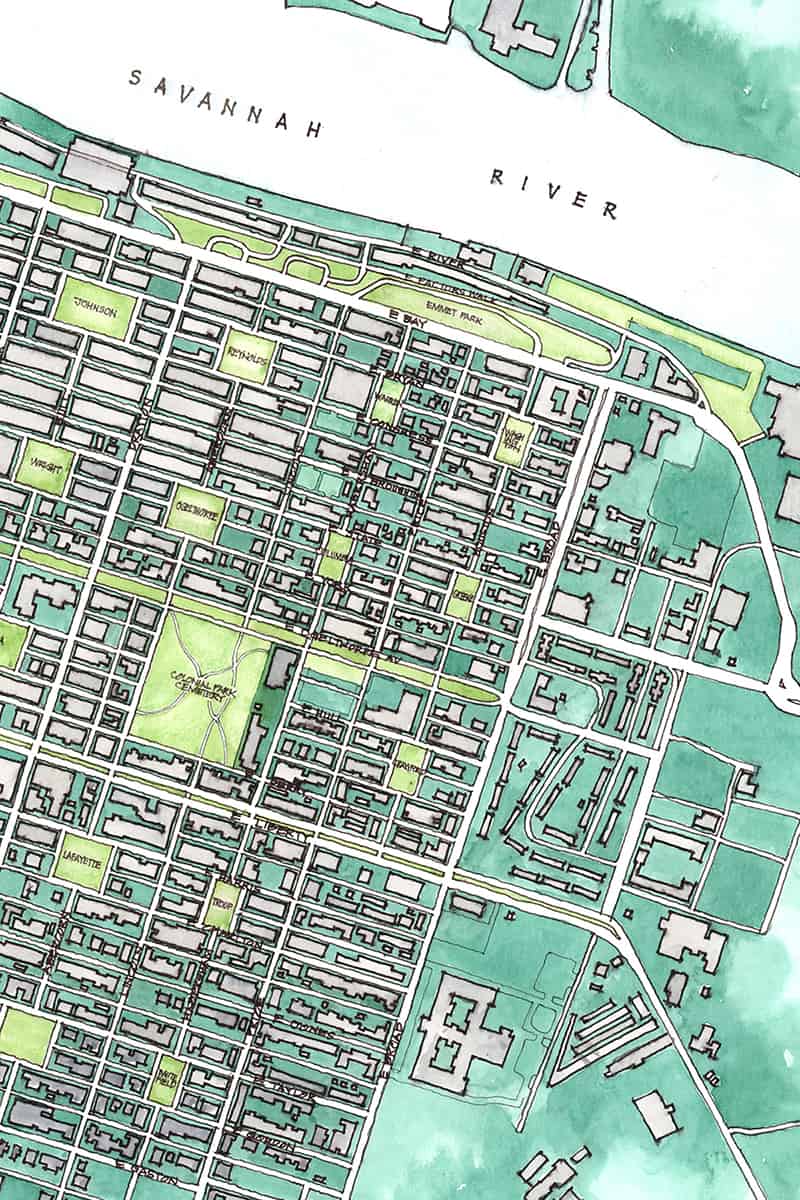
Savannah’s local historic protections cover two adjoining but separately regulated areas: the Downtown (Landmark) Historic District and the Victorian Historic District, both administered under the same design-review ordinance by the Metropolitan Planning Commission’s Historic Preservation Department. The Downtown district is divided into historic wards, small clusters of blocks organized around a square, which double as the unit the short-term rental cap is measured against, covered below.
Not every building inside the boundary carries equal legal weight. Since 1966, when the city established the Historic District Board of Review, every parcel has been sorted into contributing or non-contributing on the Historic Buildings Map, expanded in 1985 to include buildings identified in a National Park Service survey; the Park Service extended the Landmark District’s period of significance to 1935. A 2023 case shows what that classification does in practice: the board declined a demolition request for two buildings at 412–414 Martin Luther King Jr. Boulevard (MPC File 23-005414-COA) after a structural engineer’s report failed to establish they were unsound, and staff found neither building had lost enough integrity to qualify for the easier non-contributing review path. The board’s decision carried a November 8, 2025 expiration, after which a new application would be required from scratch.
The practical implication for a buyer: a non-contributing designation generally opens an easier review path, up to and including demolition, but that status is a formal entry in the MPC’s Historic Resources Survey, not a judgment call based on how old or new a house looks from the sidewalk. Confirming it before writing an offer means asking the MPC Historic Preservation office for the parcel’s designation.
The Certificate of Appropriateness Process
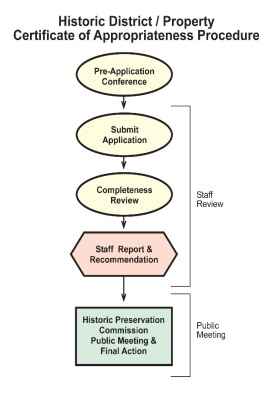
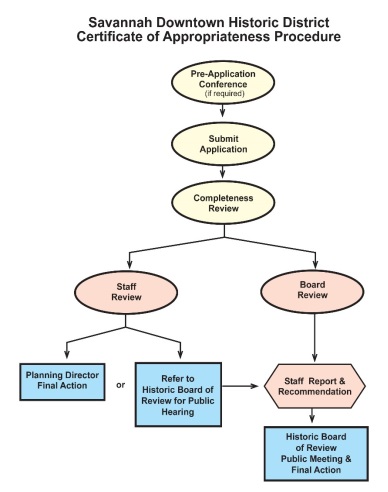
All exterior changes visible from a public right-of-way, including lanes, require a Certificate of Appropriateness (COA) from the Historic District Board of Review, a nine-member volunteer board appointed by the Mayor and Aldermen. The ordinance splits review into two tracks. Staff-level review covers routine, reversible items and typically closes in up to 10 business days once a complete application is filed. Board-level review covers rehabilitation, additions, new construction, signage, fences, and demolition or relocation, and a complete application is docketed for the board’s next available monthly meeting rather than reviewed on a fixed clock; new construction, additions, and accessory buildings such as carriage houses require a pre-application meeting with staff before that clock even starts.
| Change type | Review level | Typical timeline |
|---|---|---|
| Paint color change | Staff | Up to 10 business days |
| Roof repair or replacement | Staff | Up to 10 business days |
| Awnings, shutters, window replacement | Staff | Up to 10 business days |
| Brick repointing, stucco repair | Staff | Up to 10 business days |
| Rehabilitation, additions, new construction | Board | Next monthly HDBR meeting (2nd Wednesday) |
| Signs, fences, demolition, relocation | Board | Next monthly HDBR meeting (2nd Wednesday) |
Source: MPC HDBR Instructions.
The split matters for scheduling a renovation around a closing: a staff-level scope can clear inside two weeks, while anything needing the board is bound to a monthly cadence, and a missed submission deadline pushes the whole project a month. A buyer planning visible exterior work should ask the seller’s contractor which track their scope falls into before setting a renovation timeline.
An application incomplete at submission cannot start either clock. Staff and the board will not begin review until every checklist item and the filing fee are received.
None of this reaches inside the front door. The Certificate of Appropriateness process governs exterior work visible from the public right-of-way; paint colors, floor plans, kitchens, and mechanical systems inside the house are the owner’s decision alone. A buyer restoring a kitchen or finishing a basement in a contributing Savannah rowhouse files nothing with the MPC for that work.
Does buying a historic home here mean I can’t renovate the interior?
No. Certificate of Appropriateness review applies to exterior changes visible from a public street or lane. Interior layout, kitchens, baths, and mechanical systems are unregulated by the MPC; only work that changes what’s visible from outside, a new window opening, an addition, a change to the roofline, triggers review.
The Cost of Skipping Approval
Short-Term Rental Rules: The Ward Cap and What Transfers at Closing
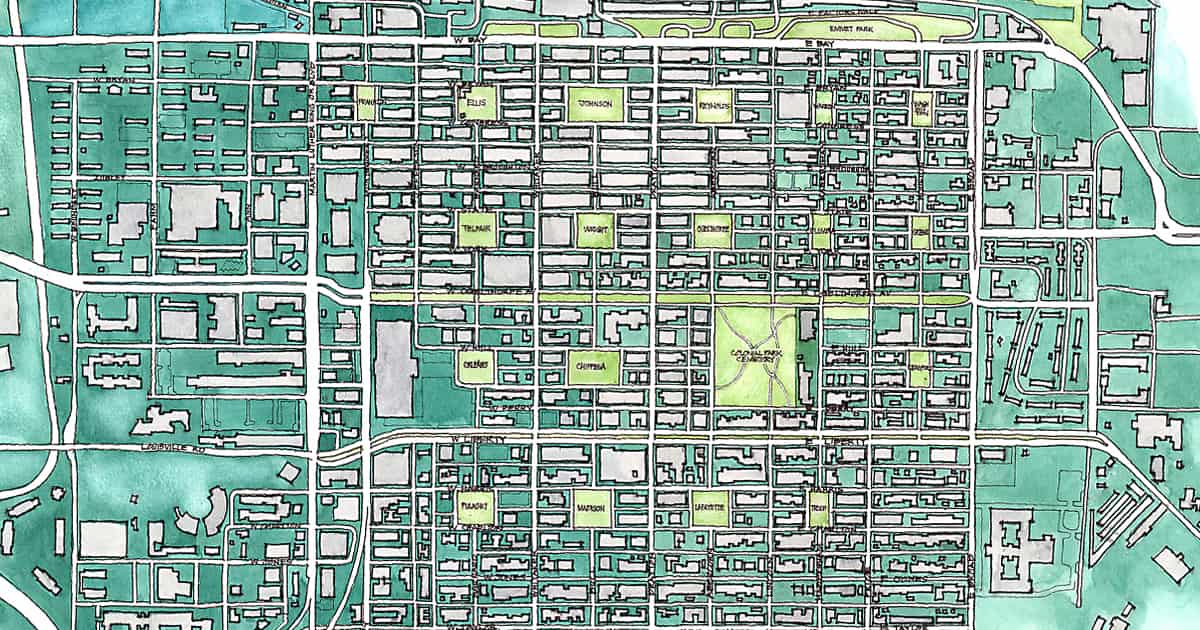
Short-term vacation rentals (STVRs), a full dwelling unit rented for 30 days or less, are permitted only inside the STVR Overlay District, which covers the Downtown, Victorian, and Streetcar local historic districts, plus a short list of business and agricultural zones outside the overlay. Since September 29, 2017, non-owner-occupied STVR certificates in the Downtown and Victorian districts have been capped at 20% of residential parcels per ward. The city’s current per-ward list shows nearly every ward already at that cap; owner-occupied applications are exempt from it.
| Permit type | Eligibility | Cap exposure | Transferability at sale |
|---|---|---|---|
| Owner-occupied STVR | Owner’s primary residence shares the parcel’s Property ID | Exempt from 20% cap | Certificate is non-transferable; new owner reapplies |
| Non-owner-occupied STVR | Any qualifying dwelling unit | Subject to 20% per-ward cap; capped wards use a first-come, first-served waitlist | Non-transferable; new owner has 6 months from title transfer to reapply without cap denial |
| Pre-September 28, 2017 certificate | Grandfathered under the prior rules | Renewals protected from cap denial | Non-transferable to a new owner; the 6-month reapplication window still applies at sale |
| Streetcar (TN-2 zoning) | Requires 2+ dwelling units, one owner-occupied | Not subject to the 20% cap | Governed by Sec. 7.5.4, separate from the Downtown/Victorian rule |
Source: City of Savannah STVR Regulations.
The table’s last column is the one worth rereading before an offer: a certificate does not follow the deed. Per Sec. 8-11012 of City Code, STVR certificates are non-transferable outright. A widely repeated shorthand in investor guides describes STVR eligibility as something that transfers or passes to a buyer along with an active listing; the ordinance describes something narrower, a limited window in which the new owner’s own application will not be denied for exceeding the ward cap, provided they file within six months of the transfer date. Missing that window on a capped ward means starting over on a waitlist some investor guides put at three or more years.
Checking a specific address before an offer takes three steps: find the property’s ward using the city’s ward map, cross-reference the current per-ward cap list on the same page, and, if the ward is capped, file the STVR Waiting List form. Verify a specific address’s certificate status directly with the city before relying on a listing’s advertised STVR income; the list changes as certificates lapse, so it is worth reconfirming close to closing.
What happens if I buy a property with an active STVR permit?
The certificate itself does not transfer to you. If the parcel had a pre-existing certificate, you have six months from the date of title transfer to file your own application without being denied for exceeding the ward cap; miss that window and you’re subject to the ordinary waitlist like any new applicant.
What Ownership Costs Beyond the Purchase Price
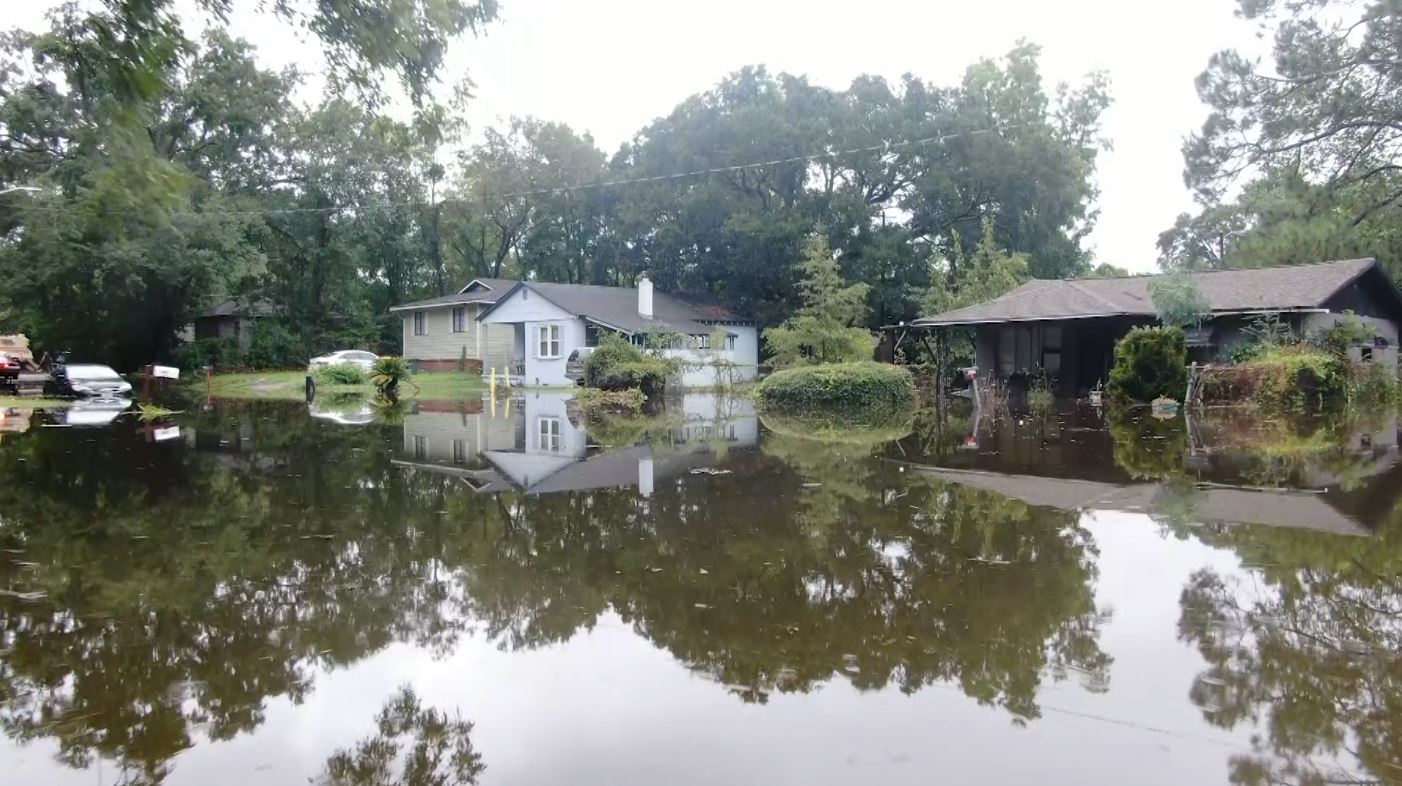
Three cost categories are specific enough to Savannah’s Historic District that a generic homebuying checklist misses them: flood exposure, wind exposure, and wood-destroying organisms.
The City of Savannah raised its required freeboard, the buffer built above the Base Flood Elevation for new or substantially improved structures, from one foot to two feet, effective January 1, 2025; the prior one-foot standard had been in place since September 2008. A separate HUD rule took effect the same day requiring the same two-foot buffer for any home to qualify for FHA financing inside a Special Flood Hazard Area. Chatham County’s “50% Rule” adds a renovation-specific trigger: if a rehabilitation’s cost exceeds 50% of the structure’s fair market value, the lowest finished floor must be raised to meet the new freeboard standard, which can turn a historic renovation budget into a flood-compliance project. FEMA’s Risk Rating 2.0 methodology no longer prices a policy off the flood zone letter alone; elevation, distance to water, and construction type carry more weight than before. Chatham County’s participation in the Community Rating System discounts NFIP premiums by 25% in high-risk A, AE, and VE zones and 10% in X and X-500 zones, worth roughly $263 annually for a typical high-risk-tier policyholder, per FEMA.

Georgia sits among 19 states, plus Washington, D.C., where insurers commonly apply a separate hurricane or named-storm deductible instead of folding wind coverage into a flat-dollar standard deductible, according to the National Association of Insurance Commissioners. These deductibles are calculated as a percentage of dwelling coverage, typically 1% to 5% and occasionally higher in coastal zones, and a hurricane deductible triggers only for storms named by the National Hurricane Center while a separate windstorm/wind-hail deductible can trigger on any wind event. Georgia has no dedicated state wind pool; hard-to-place coastal risks go through the private market or the Georgia Underwriting Association.
Georgia’s Structural Pest Control Act requires the state’s official wood-destroying organism inspection report for most closings, issued only by a licensed operator. It is not a legal requirement of the sale itself, but most lenders, and typically the seller under VA loan terms, require a current one, and the report is generally treated as valid for around 90 days. A pre-existing termite bond on the property does not automatically follow a new owner: contracts vary on transfer fees, re-inspection requirements, and whether coverage lapses if a transfer isn’t completed within a set window after closing.
| Risk factor | How to check | Action before offer |
|---|---|---|
| Flood zone and freeboard exposure | FEMA Map Service Center or SAGIS parcel lookup | Ask whether the structure meets the post-2025 freeboard standard; request an elevation certificate if one exists |
| Wind/named-storm deductible exposure | Ask the seller’s current insurer or an independent GA-licensed agent | Get a same-coverage quote before waiving the insurance contingency |
| Wood-destroying organism status | Request the seller’s most recent Georgia WDO report | Confirm the report is within its ~90-day validity |
| Existing termite bond transferability | Ask the pest control company directly, not just the seller | Confirm transfer fee, re-inspection requirement, and any post-closing deadline |
Sources: Savannah Flood Protection Information; Chatham County flood facts; NAIC hurricane deductibles; Georgia Structural Pest Control rules.
The four rows above map onto four separate professionals: a surveyor, an insurance agent, a licensed pest control operator, and, for the bond specifically, a phone call the buyer makes directly rather than through the listing agent.
Do I need flood insurance if I’m not directly on the river?
Possibly, and even where it isn’t required, it’s worth pricing. Elevation and distance to water both factor into current NFIP pricing under Risk Rating 2.0, and a home outside a mapped high-risk zone can still flood. Lenders generally require coverage only inside a Special Flood Hazard Area, but that boundary is parcel-specific, so check the exact address instead of judging by how far it looks from the river.
Financial Incentives for Rehabbing a Historic Home

Georgia runs three distinct incentive programs for historic rehabilitation, and they do not all apply to the same buyer.
The state’s Preferential Property Tax Assessment freezes a county’s property tax assessment at its pre-rehabilitation level for eight full years, with the ninth year adding half the difference between the frozen and current assessed value and the tenth year returning to full current assessment: an 8.5-year effective freeze. Qualifying requires the rehabilitation to raise the property’s fair market value by at least 50% for an owner-occupied residence, administered jointly by the state’s Historic Preservation Division and the county tax commissioner.
Georgia’s separate state income tax credit returns 25% of qualifying rehabilitation expenses, capped at $100,000 for a personal residence and $300,000 for an income-producing property, applied dollar-for-dollar against state tax owed.
The federal rehabilitation tax credit, administered by the National Park Service and the IRS, returns 20% of qualified expenses, but only for income-producing properties; an owner-occupied primary residence does not qualify for the federal credit at all, regardless of how extensive the rehabilitation.
Georgia’s new Historic Home Tax Credit Program closes that gap. Applications opened October 1, 2025, for owner-occupied primary residences that are either locally designated or contributing to a local historic district; eligible rehabilitation work cannot begin before the program’s January 1, 2026 effective date. A competitor page written even a few months earlier would not mention this program at all.
Is my historic home automatically eligible for tax credits?
No single filing covers all three programs. Eligibility for the state tax freeze and the state income credit both run through Georgia’s Historic Preservation Division and require the property be listed in, or eligible for, the National or Georgia Register, individually or as a contributing structure in a district; the federal credit requires income-producing use specifically. Confirm which program a given address qualifies for before budgeting a rehab around expected credits.
Price by Sub-District

| Sub-district | Median sale price | Price per sq. ft. | Median days on market | As of |
|---|---|---|---|---|
| North Historic District | $699,000 | $666 | 57 | July 2025 |
| South Historic District | $1,000,000 | $526 | 163 | March 2026 |
Source: Redfin, North Historic District; Redfin, South Historic District.
These two snapshots are ten months apart, not the same month, because that’s the most recent published data for each sub-market at the time of writing; treat the gap as a limitation of any North-vs-South comparison, not a rounding error. North sold faster and at a lower price per square foot in mid-2025 than South did in early 2026, and South’s days on market ran nearly three times longer over the same year-over-year window. A buyer weighing speed of resale against absolute price ceiling is looking at two sub-markets moving on different clocks of their own, not one district with two price tiers.
Is the North or South Historic District a better investment?
Neither is categorically better; they’ve moved differently on different timelines. North sold faster and cheaper per square foot as of mid-2025; South commanded a higher absolute median but took nearly three times as long to sell as of early 2026. Pull current numbers for the month you’re transacting in rather than relying on either snapshot above.
Who This Fits

An owner-occupant planning visible exterior work should budget the monthly board-review calendar into the project timeline and ask early about eligibility for the new Historic Home Tax Credit. An investor chasing STVR income should assume the target ward is capped and verify the specific address’s certificate status directly with the city before pricing any deal on advertised rental income. A buyer optimizing for long-term appreciation over rental income has more flexibility on ward and STVR exposure, since none of those mechanics apply to a property that won’t be rented short-term, but still inherits the same COA and contributing-status rules on any future exterior work.
Comments