
Where the ratings disagree, and why
A renter checking two review platforms for the same address sees two different pictures, and neither platform tells you why.
| Platform | What it measures | Score | Scale | Sample size |
|---|---|---|---|---|
| Apartments.com | Blended renter rating | 1.9 | out of 5 | 7 reviews (5 one-star, 1 three-star, 1 five-star) |
| ApartmentRatings.com | Grounds condition | 3.0 | out of 5 | Drawn from a 462-review base |
| ApartmentRatings.com | Maintenance | 3.0 | out of 5 | Same base |
| ApartmentRatings.com | Noise | 3.5 | out of 5 | Same base |
| ApartmentRatings.com | Safety | 3.1 | out of 5 | Same base |
A 7-review average and a several-hundred-review dimension breakdown aren’t the same instrument. Seven reviews on Apartments.com is a small enough sample that one or two angry move-outs set the whole number; five of the seven are one-star. ApartmentRatings splits its much larger sample into specific categories instead of one blended figure, and every one of those categories lands at “below average” to “average,” not at a number resembling 1.9. Neither site tells you this when you land on it.
The detail worth reading past the headline number: one of the more recent ApartmentRatings entries describes a six-month unresolved dispute over mold traced to a malfunctioning HVAC unit, plus a disputed towing attempt the reviewer had to stop in person. That’s a specific, checkable pattern, ask about HVAC service history and towing or parking enforcement on a tour, not a generic complaint.
Is the 1.9-star rating on Apartments.com the full picture? No. It’s a real number from a small sample. A larger-sample source (ApartmentRatings, 462 reviews) scores the property’s grounds, maintenance, noise, and safety separately, and every one of those lands at “average” or “below average,” not at anything close to 1.9 out of 5.
The real move-in cost
The advertised floor, $1,252, is base rent only. Every one of these charges is separate.
| Cost item | Amount | One-time or recurring | Source |
|---|---|---|---|
| Application fee | $50 per applicant | One-time | Apartments.com Fees & Policies |
| Holding / reservation fee | $500 | One-time, refundable if canceled within 72 hours | Same |
| Security deposit (standard) | $500 | One-time, refundable at move-out | Same |
| First-lease amenity fee | $600 | One-time or recurring, per unit | Same |
| Utility new-account setup | $10 | One-time | Same |
| Parking (unassigned) | $95 to $115 per month | Recurring | Same |
| Pet fee, if applicable | $350 one-time plus $50 per month, per pet, max 2 | Both | Same |
Add the one-time items to the cheapest available base rent and a studio’s real first-month cost sits closer to $2,400 than to $1,252, before any pet or parking charge. Utilities (electric, gas, water, sewer, trash) are billed separately and usage-based, so they aren’t fixed figures a listing can quote.
Studio rent in the surrounding Wynnefield Heights submarket averages $1,276 and one-bedrooms average $1,656, against $1,429 and $1,786 citywide; Presidential City’s studio floor undercuts both, though its top-end penthouse pricing runs well above any neighborhood average.
Does the listed rent include all required fees? No. The advertised number is base rent. The application fee, holding fee, security deposit, and first-lease amenity fee are separate and due before or at move-in; parking and pet costs are ongoing on top of that.
Four buildings, four different apartments
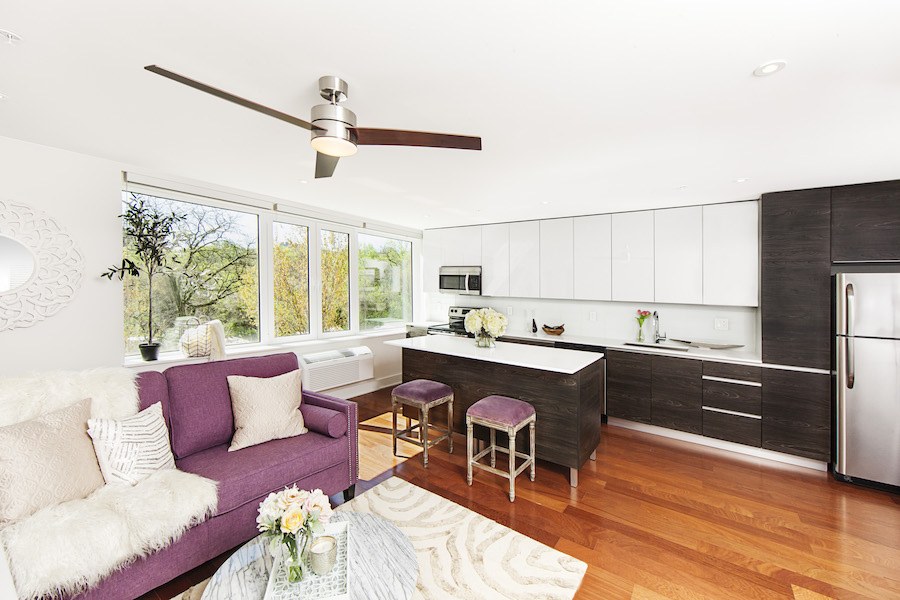
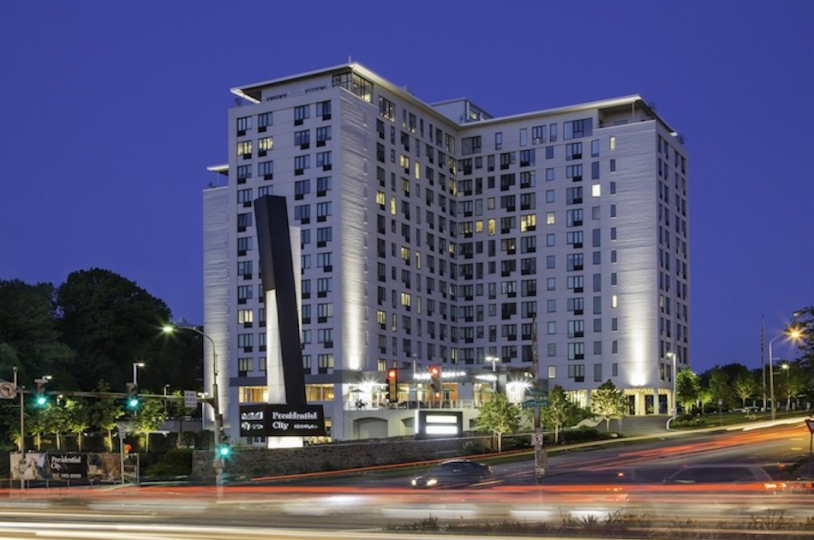
“Presidential City” isn’t one building with one interior style. It’s four separate 12-story towers, each renovated with its own character, and which one a unit sits in changes the experience more than the marketing copy suggests.
| Building | Renovation order | Signature feature | Interior character |
|---|---|---|---|
| Washington | First, completed 2015 | Renovated ahead of the other three towers | Original launch building |
| Madison | 2016 | Barista-bar coworking lounge; houses the on-site leasing gallery | Contemporary, urban-loft |
| Adams | 2016 | Library and a children’s play center | Boutique-lobby feel |
| Jefferson | 2016 | No additional distinguishing amenity found in published sources beyond the general renovation | Minimalist |
If a specific interior style or amenity set matters, a library, a play center, the coworking lounge, it’s worth asking the leasing office to confirm which building a unit is actually in before touring, since floor plan names on the major marketplaces don’t always surface the building.
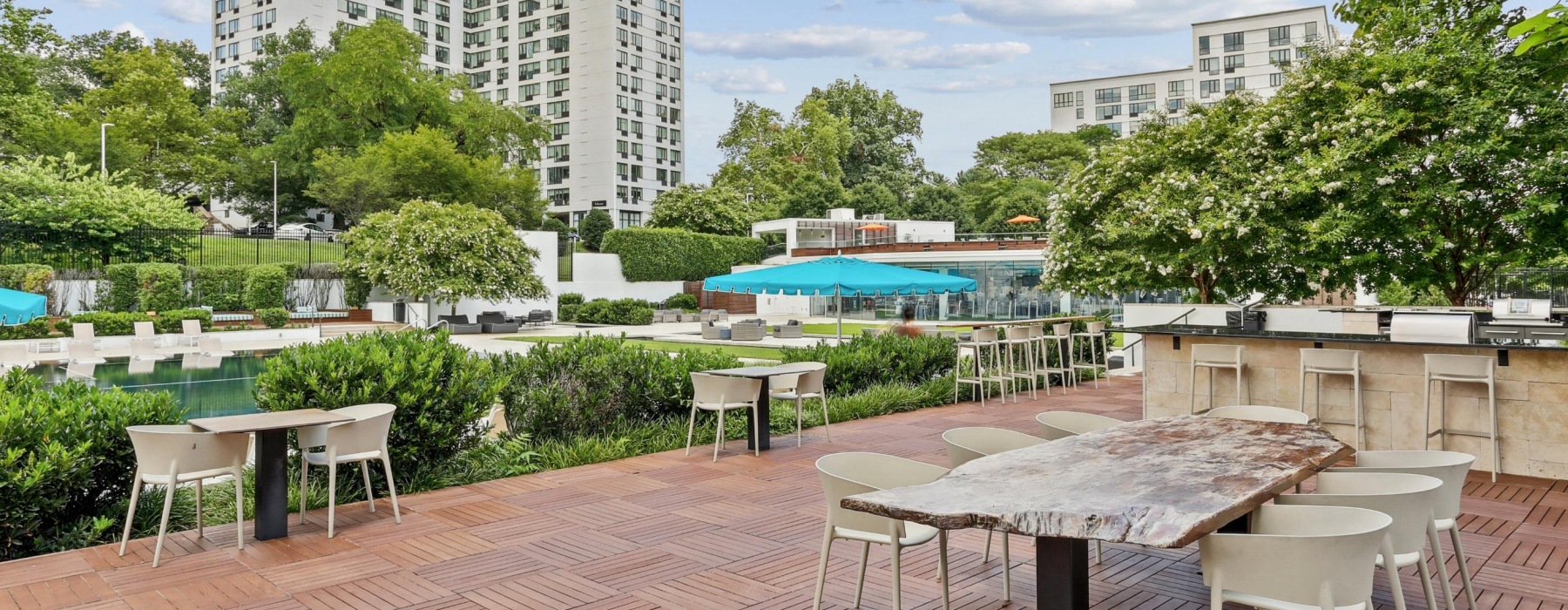
Post Brothers built the shared amenity space, Sora Pool Club and Spa, as a roughly $7 million, 41,000-square-foot addition separate from the four residential towers. It remains the property’s central shared amenity today, with multiple pools and a fitness center.
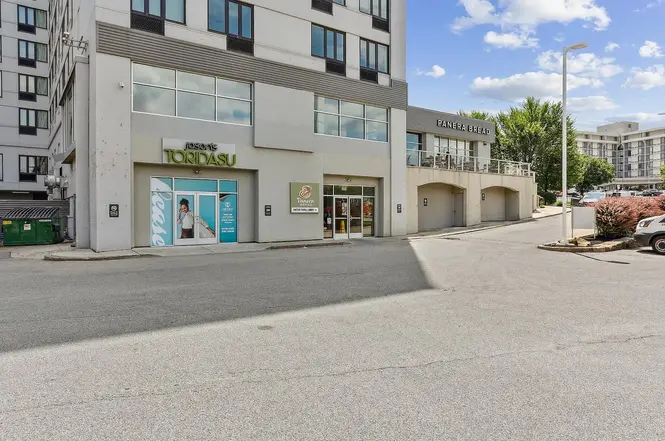
A ground-floor Panera Bread sits within the complex as one of the few on-site retail tenants, a small but concrete detail that shows up in property coverage going back to the original 2015 renovation.
Ownership and management: three operators since 2012
The property changed operators twice in the past four years, and that shift shows up directly in resident sentiment. Post Brothers bought the complex in 2012 and ran a roughly $100 million gut renovation completed building by building through 2016. In November 2022, Post Brothers sold the property to KKR and Mack Real Estate Group for approximately $357 million, the most expensive multifamily sale in Philadelphia’s history, and Mack Property Management took over daily operations. The property is now managed by the Bozzuto Group. Resident reviews on Bozzuto’s own listing page reference all three operators directly, several unfavorably comparing current management to Post Brothers and Mack Management, and describe a recent switch to a third-party parking vendor that introduced new guest-parking charges.
Has management changed recently? Yes, twice in under four years. Post Brothers managed the property through 2022, when new owners KKR and Mack Real Estate Group installed Mack Property Management; the property is now managed by Bozzuto.
Location: sitting on the Philadelphia and Montgomery County line
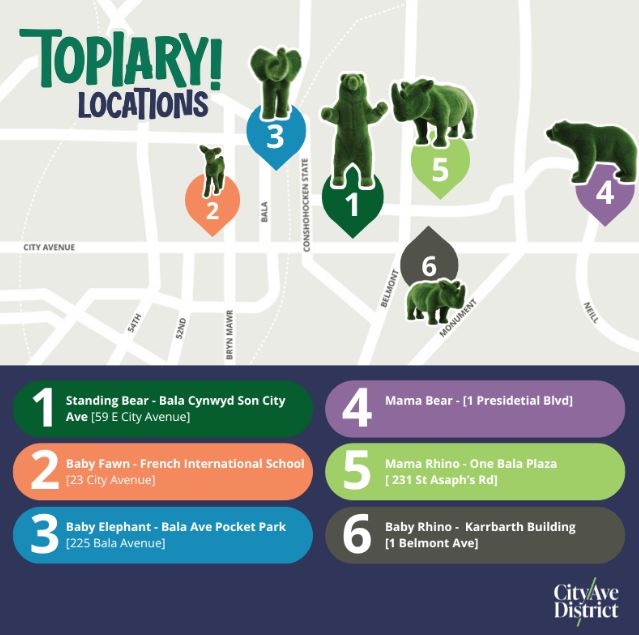
City Avenue is the boundary between Philadelphia and Lower Merion Township in Montgomery County. Presidential City sits on the Philadelphia side, and at 1,015 units is the largest existing residential complex on that side of the line, while the Lower Merion side has added hundreds of new apartment units since 2019 with more approved. That boundary is why “nearby schools” listings sometimes mix Philadelphia public schools with Lower Merion School District schools for the same address, and it’s a real reason renters search this property by name rather than by neighborhood.
| Metric | Score | Scale | Provider |
|---|---|---|---|
| Walk Score | 60 | out of 100 | Local Logic |
| Transit Score | 70 | out of 100 | Local Logic |
| Drivability | 100 | out of 100 | Local Logic |
| Bike Score | 50 | out of 100 | Local Logic |
| Soundscore (traffic noise) | 69, rated “Active,” traffic “Busy” | out of 100 | HowLoud |
Every one of those numbers comes from the same provider pairing on the same listing page, so there’s no cross-provider conflict to flag here. The honest read is that the location is car-friendly first at 100 out of 100 for drivability, transit-adequate second, and moderately walkable, with real traffic noise from the adjacent Schuylkill Expressway interchange.
Is Presidential City in Philadelphia or Lower Merion Township? Philadelphia. The address sits on the city side of City Avenue, which is the Philadelphia and Montgomery County boundary; Lower Merion Township starts on the other side of the road.
What residents complain about, specifically
Beyond the aggregate scores, a few complaint categories recur across the platforms searched: a documented mold and HVAC dispute that went unresolved for months rather than days; a recent shift to a third-party parking vendor that added guest-parking fees where none existed before; and inconsistent enforcement or communication that residents describe changing with each new management team. None of these show up in the marketing description, and none of the major marketplace listings mention them at all.
Who tends to live here
Reviewers across platforms skew toward renters affiliated with nearby institutions, Penn, Drexel, Temple, and Saint Joseph’s, given the property’s location relative to those campuses, alongside young professionals commuting into Center City by car or the SEPTA bus routes that serve City Avenue. That’s an observed pattern in the review population, not a recommendation.
Comments