
What Buying a Condo Here Involves
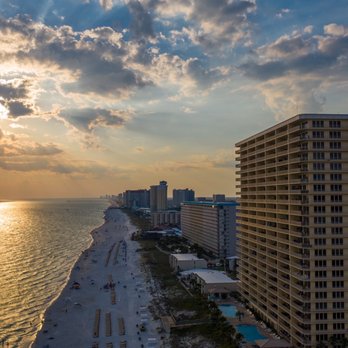
A Florida condominium purchase buys a unit plus a fractional interest in a legal entity, the condominium association, that owns and insures everything outside the unit’s walls: the roof, the pool, the elevators, the parking deck. That association carries the master insurance policy on the building, funds a reserve account for future repairs, and can levy a special assessment against every owner when the reserve falls short. Chapter 718 of the Florida Statutes governs how associations budget and disclose those obligations. Everything below traces back to how well a given association has managed that structure.
Current Market Snapshot and Price Trend
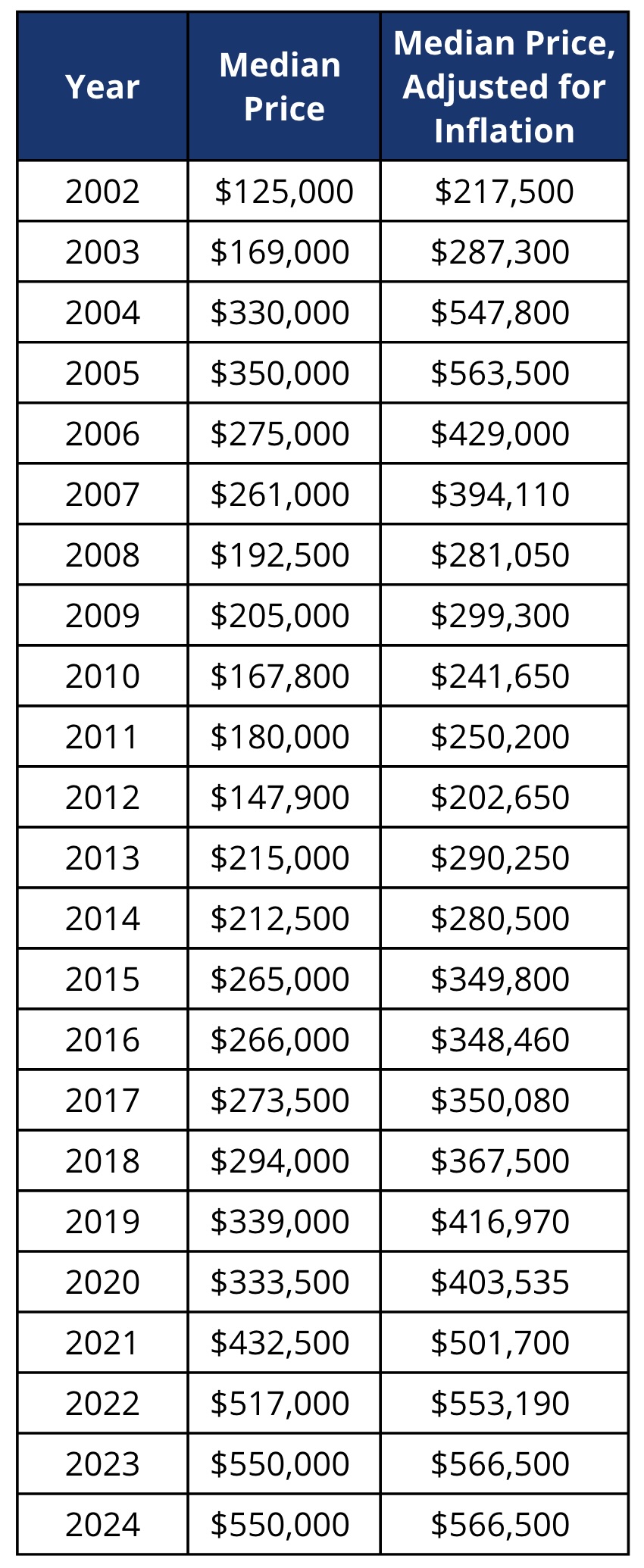
Panama City Beach’s condo-heavy housing market posted a $384,000 median sale price over the three months ending May 2026, a decline of 4.1% from the same period in 2025 (Redfin). Price per square foot moved the other direction, up 0.9% to $329, and the typical listing took 106 days to sell, three days longer than a year earlier.
| Metric | Current (3 mo. through May 2026) | Year-earlier period | Direction |
|---|---|---|---|
| Median sale price | $384,000 | ~$400,600 (implied by -4.1%) | Down 4.1% |
| Median price per square foot | $329 | ~$326 | Up 0.9% |
| Average days on market | 106 days | 103 days | Up 3 days |
A falling median price alongside a rising price per square foot points to smaller, lower-priced units moving fastest while larger gulf-front units sit longer: a mix shift more than a broad price correction.
Is a Panama City Beach condo really a better investment than one in Destin or 30A?Ask for the actual numbers before accepting the claim: current per-square-foot pricing, achieved short-term rental income, and HOA dues for the specific buildings being compared. A verbal comparison without those three figures is not evidence.
Rental Income and Short-Term Rental Rules
Short-term rental of a Panama City Beach condo is legal if the unit sits inside city limits and holds a current Vacation Rental Certificate under Ordinance 1632, and separately if that specific condo association’s bylaws permit it.
Panama City Beach’s Ordinance 1632, effective February 1, 2024, requires every vacation rental inside city limits to carry a Vacation Rental Certificate, pass an annual fire-safety inspection, and post occupancy and safety information inside the unit; new registrations cost $250 plus a $75 inspection fee, and re-registration runs $150 (City of Panama City Beach). Occupancy is capped at one person per 150 square feet of habitable space, or one per 200 square feet if the unit passes its life-safety inspection without violations.
Bay County passed a separate registration ordinance in 2023 for unincorporated areas outside city limits, but that county ordinance currently exempts high-rise condominium buildings and applies only to one- to four-family structures, so most PCB high-rise condo towers fall under the city rule depending on the exact parcel (The Offer Sheet, citing Bay County Ordinance 23-18). Even where both rules allow rentals, an individual association’s bylaws can set stricter limits such as minimum-stay requirements or an outright cap, and those bylaws bind an owner regardless of what the municipality permits.
Can I legally short-term-rent a condo I buy here?Only if three permissions line up: the unit’s location determines whether Ordinance 1632 or a lighter county rule applies; it holds a current Vacation Rental Certificate and annual fire inspection; and the specific condo association’s bylaws don’t cap or forbid short-term stays. City rules and lax county rules never override a restrictive association.
Building Age, Inspections, and Dues: What Actually Varies
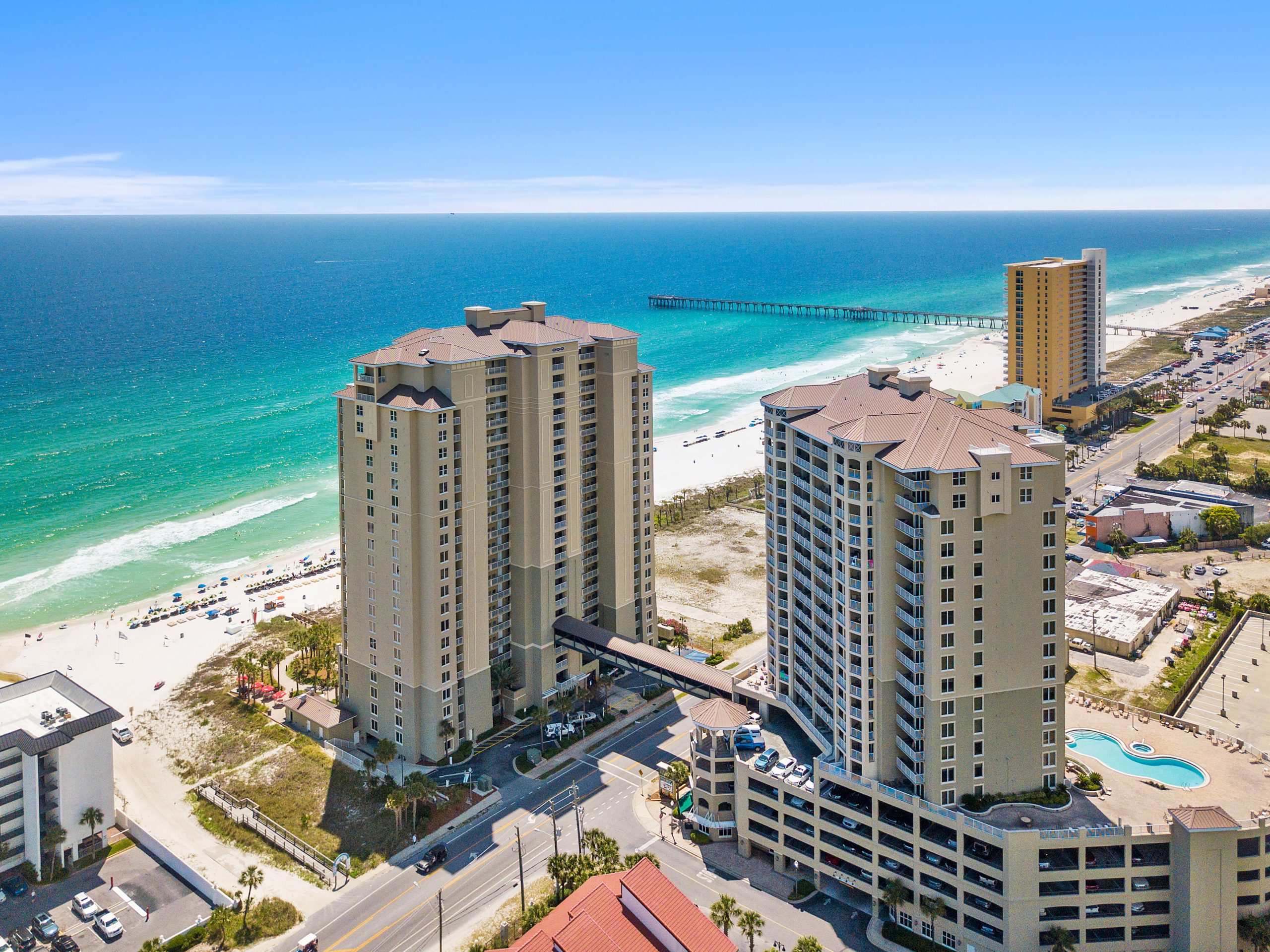
Florida’s milestone inspection law (Section 553.899) and its companion Structural Integrity Reserve Study requirement, both tightened after the 2021 Champlain Towers South collapse, apply to every residential condominium three or more habitable stories tall once the building turns 30, or 25 in some coastal jurisdictions, and PCB’s condo stock, built mostly between the mid-1970s and the mid-2000s, is now working through that requirement in real time.
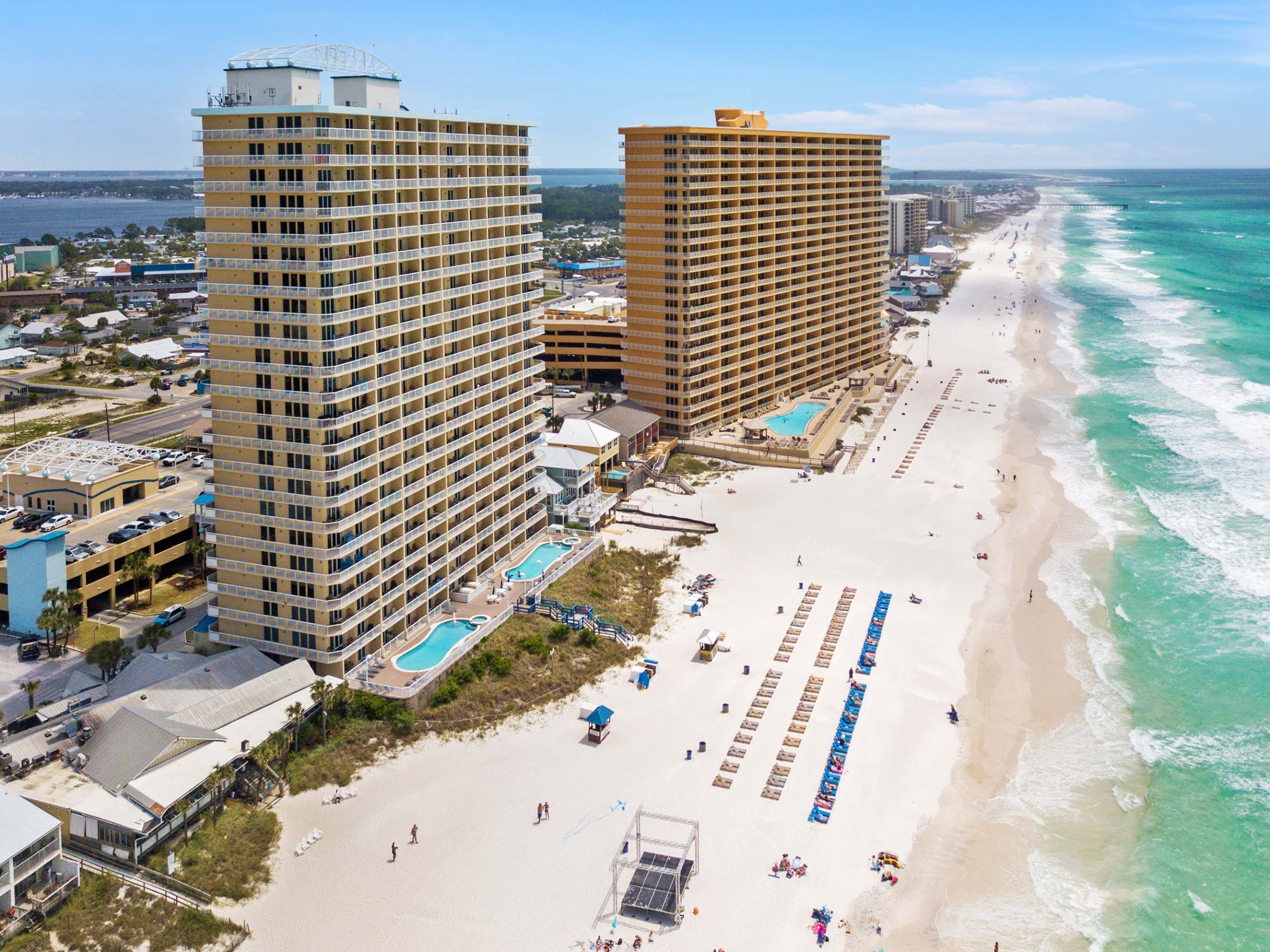
Dunes of Panama, the roughly 1,500-foot beachfront complex on Thomas Drive, illustrates the spread: it comprises six buildings totaling 326 units built between 1974 and 2001 (Homes.com). Its oldest tower crossed the 30-year inspection trigger back in 2004, long before the current law existed, and has since cycled through at least one statutory inspection under the post-2021 rules; its newest building, completed in 2001, won’t hit that 30-year threshold until 2031.
| Building | Buildings / units | Construction span | Inspection-trigger status | Typical monthly dues |
|---|---|---|---|---|
| Dunes of Panama | 6 buildings, 326 units | 1974–2001 | 1974–1985 buildings already past the 30-year mark, cycling through the statutory 10-year schedule; the 2001 building crosses 30 years in 2031 | Not independently verified for this page; request the specific building’s current SIRS and budget |
| Aquavista | 2 towers, 188 units | 1985 | Crossed 30 years in 2015; already subject to at least one full inspection cycle | No public per-building figure was located during research |
| Market-wide 2-bedroom condo, all buildings | – | – | – | $500 to $1,400/month, median near $831/month |
Every building on this list built before the mid-1990s has already gone through Florida’s inspection trigger at least once; the open question for a specific unit for sale is whether that inspection and its resulting SIRS closed clean or left a funding gap still working through the budget.
What’s a special assessment, and how do I check whether one is coming?A special assessment is a one-time charge the association levies when routine dues and reserves can’t cover a required repair, often a finding from a milestone inspection or SIRS. Ask for the association’s most recent SIRS report, the last two years of board minutes, and the current reserve balance measured against the SIRS-recommended funding schedule before making an offer.
Milestone Inspections and SIRS, Explained
Under Florida Statute 553.899, a Phase 1 milestone inspection is a licensed engineer’s or architect’s visual assessment; if it finds substantial structural deterioration, a Phase 2 inspection follows, potentially with destructive testing, and required repairs must begin within 365 days of the local enforcement agency receiving that Phase 2 report (DBPR). Buildings that reached 30 years of age before July 1, 2022 needed their initial inspection by December 31, 2024; those crossing 30 years between July 2022 and the end of 2024 had until December 31, 2025. A separate Structural Integrity Reserve Study is required at least every 10 years for the same class of buildings, and associations aligning it with a milestone inspection due by the end of 2026 have until December 31, 2026 to complete both together.
Financing a Condo Here
A buyer’s credit score and down payment matter less than the building’s status once a lender runs a standard Fannie Mae or Freddie Mac condo project review, because both agencies can declare an entire building ineligible for conforming loans regardless of any individual unit or owner.
Warrantability: Why the Building Matters as Much as the Buyer
Fannie Mae’s Selling Guide lists unfunded critical repairs above $10,000 per unit, a failed structural or mandatory jurisdictional inspection, and inadequate master insurance as automatic disqualifiers for an entire project (Fannie Mae). A project that is “primarily transient,” meaning it operates like a hotel with centralized short-term rental management, is separately ineligible outright, and a project where more than 50% of units are non-owner-occupied investor holdings loses eligibility for new investment-property loans even where owner-occupant financing stays available (Fannie Mae Condo Status Finder). For a market built substantially around rental income, that second point deserves attention before falling for a specific unit: the more a building leans into resort-style, professionally managed short-term rental, the closer it sits to Fannie Mae’s condotel line.
Will a lender finance a unit in an older or heavily short-term-rented building?It depends on the building. Ask the listing agent whether the association has ever been flagged “unavailable” in Fannie Mae’s Condo Project Manager, whether more than half the units are investor-owned, and whether any special assessment tied to a critical repair remains unpaid; any of those three can push the project out of conforming-loan eligibility.
Where to Look: Area and Rental Suitability

| Sub-area | Typical price position | STR character | Notable proximity |
|---|---|---|---|
| Front Beach Road (central) | Gulf-front premium, highest of the four | STR-permissive inside city limits under Ordinance 1632; verify association rental minimums | Walking distance to Pier Park in stretches |
| Thomas Drive / Lower Grand Lagoon (east end) | Lower entry price than central Front Beach Road | City rules apply where the parcel is inside PCB; some parcels sit in unincorporated Bay County, where high-rise condos are currently exempt from county registration | Near Frank Brown Park; farther from Pier Park |
| Pier Park corridor / west end | Walkability premium | City rules apply | Adjacent to more than a million square feet of retail and dining |
| Far west end (Sunnyside, Laguna Beach area) | Typically the lowest entry price of the four | Mixed jurisdiction; confirm parcel status with the Bay County Property Appraiser | Quieter; farthest from Pier Park |
Who This Isn’t a Good Fit For
- Guaranteed-income short-term renters eyeing a 1970s or 1980s tower with an unresolved SIRS finding. Financing risk and assessment risk stack here at the same time.
- Buyers relying entirely on conventional financing who haven’t confirmed the specific building’s Fannie Mae or Freddie Mac status first. A perfect credit file doesn’t fix an ineligible project.
- Buyers wanting flat, predictable monthly costs. Dues on older Gulf-front buildings can jump sharply the year a SIRS reveals a funding gap.
Insurance Reality for Gulf-Front Owners
The state’s condo insurance market turned a corner in 2026: Citizens Property Insurance Corporation cut multiperil rates by an average of 8.8% effective July 1, 2026, and its policy count has fallen 76% from its October 2023 peak to about 336,000 as private carriers re-entered the market (Citizens Property Insurance Corporation). American Coastal, the carrier writing the most Florida condo association policies, separately reported commercial property premiums down 16.6% year over year through the first quarter of 2026, the first material reversal since the crisis began (Mosaic HOA).
That statewide easing doesn’t erase the Gulf-front math for an individual buyer. A unit owner still needs a walls-in HO-6 policy layered on top of the association’s master policy, and flood coverage sits outside both, available only through the National Flood Insurance Program or a private flood carrier.
Is condo insurance in Panama City Beach getting cheaper in 2026?The statewide direction is down for the first time since 2015, with Citizens cutting rates and private carriers returning, but a specific building’s master premium still depends on its age, roof condition, and claims history. Ask for the current master policy premium and deductible before assuming the statewide trend applies to a particular tower.
Comments