
Neighborhood pricing by borough and tier
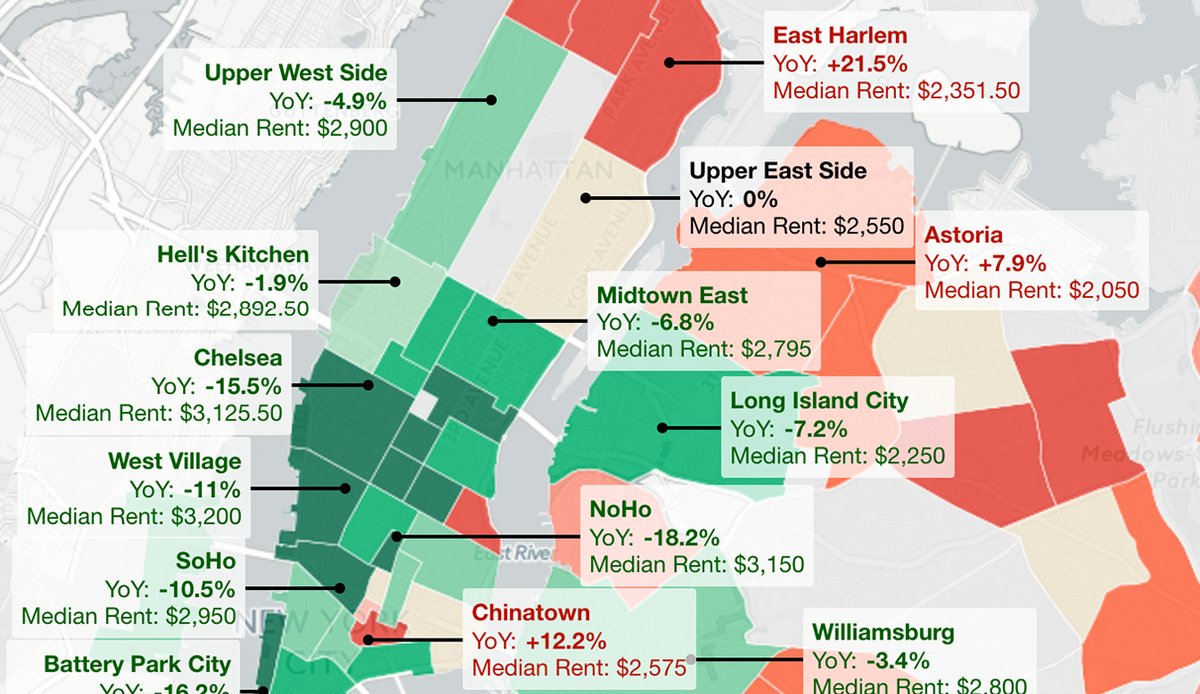
Citywide, the median asking rent climbed to $3,950 in February 2026, up 8.2% from a year earlier. That single number hides a wide range: the same StreetEasy report puts Manhattan at $4,700, Brooklyn at $3,750, and Queens at $3,150, each figure up between 5% and 7% year over year. Below the borough level, individual neighborhoods move independently of their borough’s average, sometimes sharply.
| Area | Borough | Median asking rent (Feb. 2026) | YoY change | Source |
|---|---|---|---|---|
| Citywide | All five boroughs | $3,950 | +8.2% | StreetEasy |
| Borough median | Manhattan | $4,700 | +6.9% | StreetEasy, above |
| Borough median | Brooklyn | $3,750 | +7.2% | StreetEasy, above |
| Borough median | Queens | $3,150 | +5.0% | StreetEasy, above |
| Financial District | Manhattan | $4,690 | n/a | StreetEasy neighborhoods-to-watch |
| East Village | Manhattan | $4,650 | +13.4% | StreetEasy, above |
| Carroll Gardens | Brooklyn | $4,500 | +2.3% | StreetEasy, above |
| Ridgewood | Queens | $3,205 | −1.4% | StreetEasy, above |
East Village’s 13.4% jump is the steepest move on this list, and it is a demand shift, not a supply one: StreetEasy’s tracking attributes it to search-volume growth rather than new construction. Ridgewood is the one entry where rent fell year over year, a reminder that “up and coming” and “getting more expensive” are not the same claim.
Is the widely cited “average Manhattan rent” figure reliable? Guides built before mid-2025 often cite figures between $2,500 and $6,000 with no date or methodology attached. Two currently published, dated trackers, StreetEasy and RentReboot, independently put Manhattan’s median within $30 of each other for February 2026: $4,700 and $4,730. Treat any Manhattan figure without a month attached as already out of date; this market moved 6.9% in twelve months.
A figure without a publication date is not a current figure in this market.
Can you qualify? The income and guarantor math
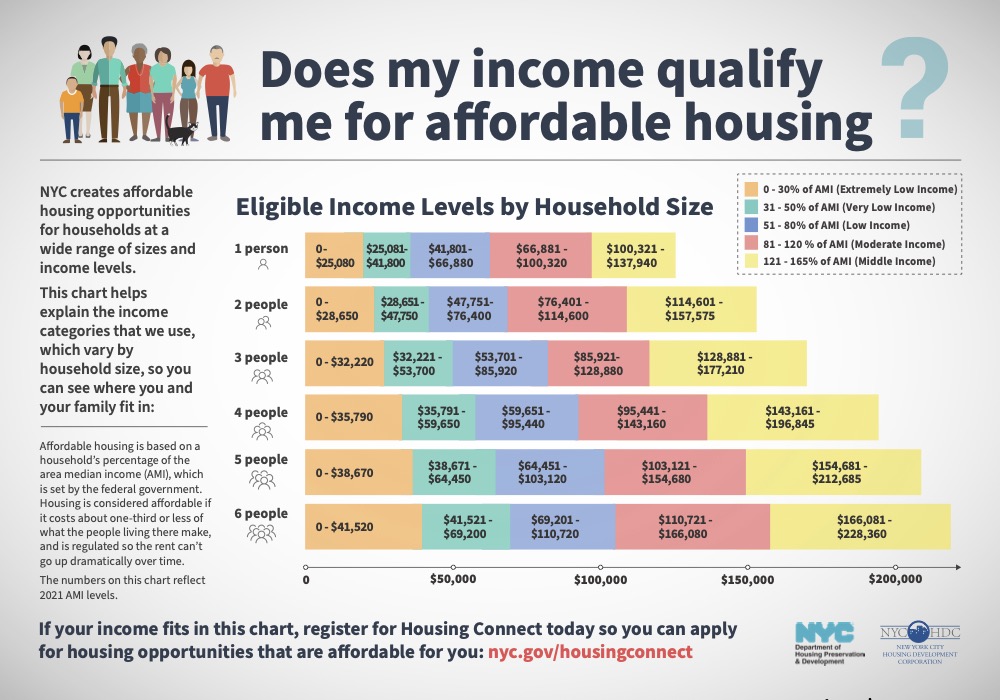
Before touring anything, run the arithmetic landlords will run on your application. New York City has no legal income requirement; the 40x rule is a private-industry convention, and individual landlords set their own thresholds.
| Requirement | Typical threshold | Workaround |
|---|---|---|
| Tenant gross annual income | 40x to 45x monthly rent | Combine roommate incomes; some landlords accept liquid-asset proof instead |
| Guarantor gross annual income | 80x to 100x monthly rent | Use an institutional guarantor service instead of a personal one |
| Guarantor credit score | ~700+ | Institutional guarantors often accept lower scores for a fee |
| Security deposit | Capped at one month’s rent | Not negotiable upward; this is a statutory ceiling, not a landlord preference |
| Application/credit-check fee | Capped at $20 per applicant | Supply your own credit report (under 30 days old) to waive it |
Sources: 40x/80x/credit figures, Brick Underground; deposit and fee caps, Brick Underground guide.
For the $3,750 Brooklyn median above, 40x means $150,000 in annual income; 45x means $168,750. A guarantor for that same apartment needs $300,000 to $375,000 a year at 80x to 100x. These norms are set building by building, not by statute, so the same income can qualify at one address and fall short two blocks away.
Can roommates combine income to qualify? Yes. Landlords generally add household incomes together and compare the total to 40x the total rent, so three roommates splitting a $4,430 two-bedroom need combined income of roughly $177,000, not $177,000 each.
If a personal guarantor isn’t available, institutional guarantor services fill the gap for a fee rather than an income test.
| Route | Cost | Income bar | Source |
|---|---|---|---|
| Personal guarantor | No direct fee | 80x to 100x rent, ~700+ credit, tri-state residency preferred | Brick Underground |
| Insurent (institutional) | ~80% to 90% of one month’s rent | Lower than a personal guarantor’s | 6sqft |
| Other institutional services (TheGuarantors, Rhino, PandaGuarantee) | ~70% to 120% of one month’s rent | As low as 27.5x monthly rent for some applicants | blog.yeonyc.com |
PandaGuarantee’s guarantor guide, updated in April 2026, lists a 27.5x minimum for applicants using its service, a bar low enough that some international students and recent graduates qualify without a personal guarantor at all.
Landlord income and guarantor norms above are common industry practice, not New York law; a building can legally set a stricter or looser bar than any figure in these tables.
What renters pay a broker after the FARE Act
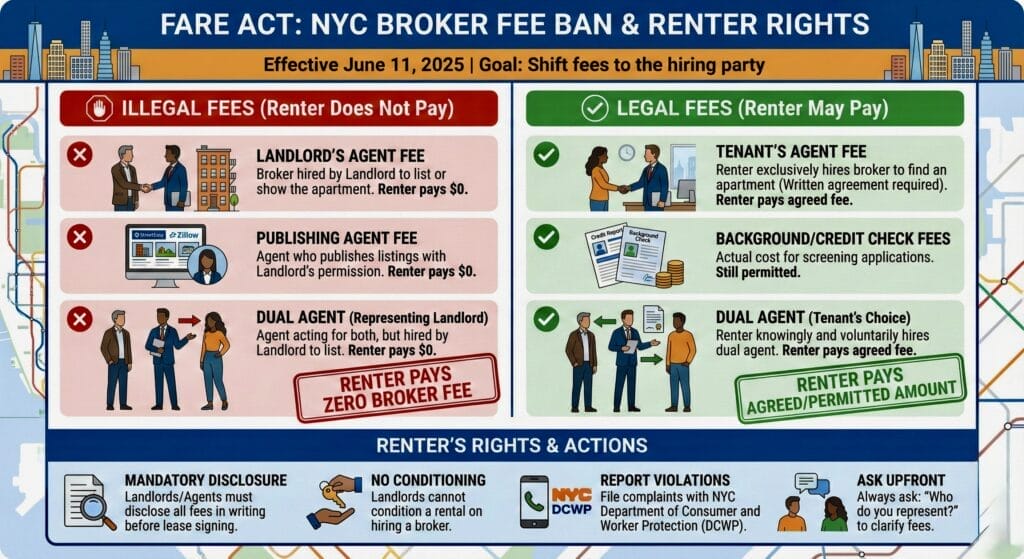
Before June 11, 2025, a renter taking a $4,700 Manhattan apartment through a landlord-hired broker typically paid 12% to 15% of the annual rent as a fee, roughly $6,768 to $8,460 on that unit. The FARE Act (Local Law 119) now assigns that fee to whoever hired the broker; if the landlord hired the listing broker, the landlord pays, and charging the tenant is a violation with a private right of action.
This does not eliminate broker fees outright. If you independently hire your own broker to search on your behalf, you still pay that broker’s fee, because you are the party who hired them. The distinction that matters at signing: did you hire this broker, or did the landlord?
Is a broker fee negotiable? Under the current law it usually shouldn’t need negotiating: if a listing broker was engaged by the landlord, the fee is the landlord’s obligation by default, not a starting offer to talk down.
Matching a neighborhood to your situation
- Families and long-term renters: rent-stabilized stock, concentrated in older Bronx, Brooklyn, and Manhattan buildings, caps annual increases and guarantees lease renewal, a bigger long-term lever than any single neighborhood choice.
- Students and recent graduates: commute distance to campus areas matters more here than headline rent; Ridgewood’s transit lines reach central Manhattan in roughly the same time as parts of western Queens at a lower entry price.
- Renters prioritizing walkability: Financial District and East Village sit near the top of the citywide range and both carry high foot-traffic density, the tradeoff for that walkability.
- Space-focused renters: Carroll Gardens skews toward townhouse and low-rise stock with more square footage per dollar than comparably priced Manhattan units, even at its current price point.
Mistakes that cost renters the most
Paying before you’ve toured the unit. New York’s Department of State’s Division of Consumer Protection recorded 9,521 real-estate and rental-scam complaints nationally in 2023, with losses over $145 million. Its guidance: never send money before an in-person or live-video tour, never pay by wire transfer, cryptocurrency, or gift card, and verify any broker’s license through the state’s eAccessNY lookup before paying anything.
Confusing “right to a roommate” with “shared liability.” New York’s Roommate Law (Real Property Law §235-f) lets a tenant bring in one additional occupant without the landlord’s consent, after notifying the landlord within 30 days. That right does not change who owes the rent. If your roommate isn’t named on the lease, you, as the sole named tenant, remain fully responsible for the entire rent if they stop paying, per the Legal Aid Society. Joint and several liability, where every signer owes the full amount, only applies to tenants who are themselves named co-tenants on the lease.
Assuming a market-rate asking price means the unit isn’t rent-stabilized. Roughly 45% of NYC’s rental units are unregulated market-rate, per the NYC Comptroller’s office, which means most of the rest carry some form of regulation, concentrated in Bronx, Brooklyn, and Manhattan buildings. The only reliable check: search the address in HCR’s Building Search tool, then request the unit’s formal rent history directly from HCR. A listing price alone tells you nothing about stabilization status.
How do I check if an apartment is rent-stabilized? Search the building address in HCR’s online Building Search tool, then request the unit’s rent history directly from HCR; the history will show every registered rent since 1984 and confirm current status.
Timing your search
Start looking about a month before your target move-in date. Most active NYC listings want tenants who can move within 30 days, so searching earlier than that mostly turns up apartments that will be gone before you’re ready to sign.
Documents to bring
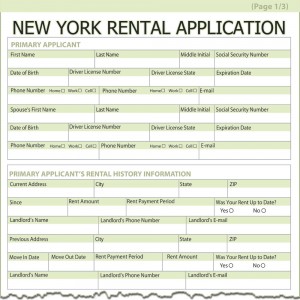
- Two recent pay stubs or an offer letter if you’re starting a new job.
- Two months of bank statements, for you and any guarantor.
- Two years of tax returns, especially if self-employed.
- A letter of employment confirming salary and start date.
- Photo ID, and for guarantors, the same package duplicated.
What documents do I need at a viewing? Bring photo ID and be ready to show proof of income on request; the full document package above is typically required only once you apply, not at the initial tour.
Comments