
Browse Texas Land
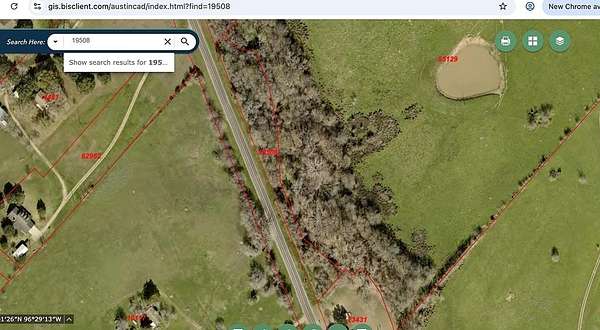
A working land search lets you filter by county, price per acre, total acreage, and land type: hunting, ranch, waterfront, or bare recreational acreage. That filtering does more to narrow a real search than another paragraph on Texas scenery would.
What Drives Texas Land Prices by Region
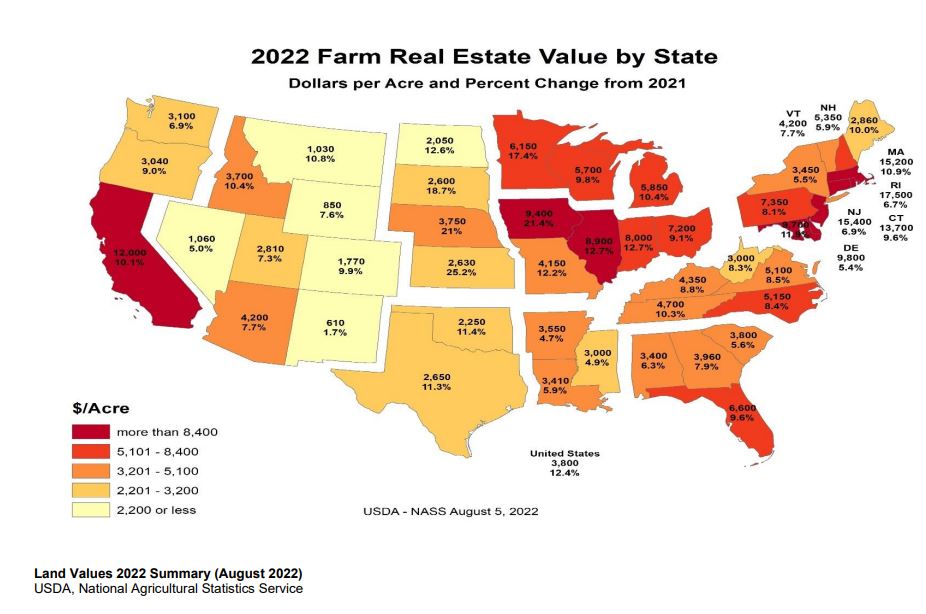
| Region | Price per acre (Q4 2025) | Year-over-year change | Key driver |
|---|---|---|---|
| Panhandle & South Plains | $1,832 | -1.61% | Row-crop and dryland farming economics; the state’s only region with a price decline |
| Far West Texas | $2,787 | +15.8% | Smaller average tract sizes pulling the mix toward higher-value parcels |
| West Texas | $2,878 | +13.49% | Ranching, plus early data-center and AI-infrastructure demand near Abilene |
| Austin–Waco–Hill Country | $7,911 | +8.15% | Proximity to the Austin metro corridor; sales volume up 10.84% alongside price |
| Northeast Texas | $9,313 | not published | Dallas–Fort Worth commuter demand; sales volume fell 18.3%, so fewer tracts traded even as price held |
| Gulf Coast–Brazos Bottom | $11,502 | +10.63% | Houston-area proximity and bottomland soil quality |
| South Texas | not separately published at this precision | sales +25.16%, dollar volume +26.53% | Strong 2025 rebound in activity, but no source publishes a comparably dated per-acre figure |
Figures are from Texas Farm Bureau’s report on the 2025 Rural Land Value Trends Report, with Far West and Northeast Texas figures from Texas Farm Credit’s 2026 land pricing guide. A tract’s region sets the baseline, but intact mineral and water rights and a documented legal easement can each move price more than the regional average does within a single region.
What Buyers Are Agreeing To on Water and Mineral Rights
Texas splits water law in two. Surface water in a river, creek, or lake belongs to the state and requires a permit to divert. Groundwater is different: under the Texas Water Development Board’s rule of capture, a landowner may pump essentially unlimited groundwater from beneath their own land, with narrow exceptions for malicious pumping or a well that slants under a neighbor’s property. Wells producing under 25,000 gallons a day for domestic, livestock, or wildlife use are exempt from permitting even inside a groundwater conservation district; larger use may need a district permit.
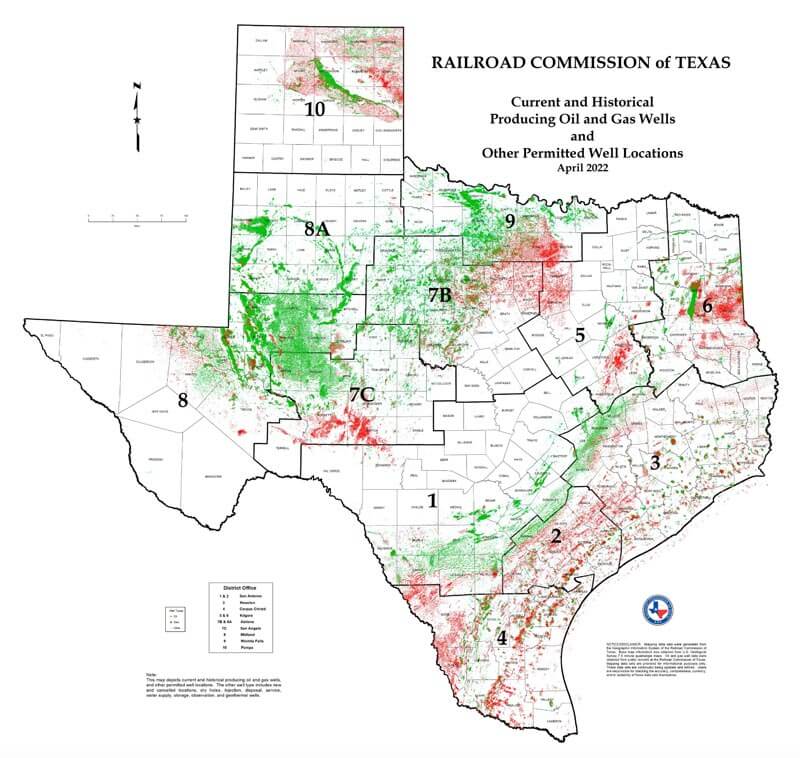
Mineral rights carry a sharper practical consequence. Where the mineral estate has been severed from the surface, common across much of Texas’s historical oil and gas country, Texas law makes the mineral estate dominant. The Railroad Commission of Texas confirms a mineral owner or lessee can drill, build access roads, and run pipelines across the surface without the surface owner’s permission and without paying for non-negligent damage. The accommodation doctrine from Getty Oil Co. v. Jones (1971) is the one real check, and it’s narrow: a surface owner must prove an existing surface use, a real conflict with that use, and a workable industry-standard alternative. A separate statute requires 15 days’ written notice before an operator drills a new well or re-enters an old one.
What happens if the mineral rights were sold separately from the surface? The buyer owns the land but not what’s under it. The mineral owner or their lessee can access the surface to develop those minerals without the surface owner’s consent, subject only to the narrow accommodation doctrine and the 15-day notice rule.
Property Taxes on Raw Land: the Ag and Wildlife Exemption
Raw land taxed at market value can carry a heavy annual bill; land qualifying for Texas’s 1-d-1 open-space agricultural appraisal is taxed instead on productivity value, frequently a small fraction of market value. Per the Texas Comptroller of Public Accounts, there’s no statewide minimum acreage; each appraisal district sets its own local threshold. The land must show agricultural use for five of the preceding seven years, and the owner files Form 50-129 with the county appraisal district by April 30. Land already qualified can convert to a wildlife-management valuation and keep the same tax treatment.
The reverse side of that benefit is the rollback tax. If the land’s use changes away from agriculture, the county recaptures the difference between what was paid under ag valuation and what would have been paid at market value for each of the prior three years, plus 7% annual interest, per the State Bar of Texas. A buyer planning to develop even part of a low-tax “ag exempt” tract should price that liability into the offer before closing.
Do I still pay property tax at full rate on raw, undeveloped land? Only if it doesn’t qualify for ag or wildlife appraisal. Qualifying land is taxed on productivity value, not market value, but changing its use later can trigger the rollback tax described above.
Financing Compared: Cash, Bank Loans, VLB, and Owner Financing
| Financing type | Typical down payment | Rate range | Term | Best fit |
|---|---|---|---|---|
| Cash purchase | 100% | n/a | n/a | Buyers avoiding lender underwriting delays; closing costs run roughly 1% to 3% of price |
| Bank or credit union raw-land loan | 20% to 50% | 1 to 3 points above residential mortgage rates | 10 to 20 years | Buyers with strong credit who want an amortizing, bank-held loan |
| VLB Veterans Land Loan | 5% minimum | posted weekly, credit-approval dependent | 30 years fixed | Eligible Texas veterans and military members, tracts up to $200,000 |
| Owner (seller) financing | Negotiated with seller | roughly 6% to 10% | Often a 5 to 10-year balloon on 20 to 30-year amortization | Buyers who can’t meet bank underwriting; requires trusting the seller’s paperwork |
Sources: Texas General Land Office; Herring Bank. A bank loan asks for a bigger down payment in exchange for a lower rate and lender-verified title work. Owner financing asks for less upfront and skips the credit check, in exchange for a higher rate and reliance on the seller’s own paperwork rather than institutional underwriting.
Is owner financing riskier than a bank loan for land? Not inherently, but the risk sits in a different place: a defaulted owner-financed contract can mean losing payments already made if the deal was structured as a contract for deed rather than a deed of trust, so confirm which structure is being used before signing.
Common Mistakes Buying Rural Texas Acreage
| Mistake | Likely consequence | How to avoid it |
|---|---|---|
| Assuming road frontage means legal access | Land can be landlocked even with a visible road nearby if that access isn’t a recorded easement | Confirm a deeded ingress/egress easement in the title commitment, not a verbal or historical arrangement |
| Skipping a mineral title search | Discovering after closing that someone else can drill on the property | A mineral title search runs roughly $300 to $500, cheap relative to the dispute it can prevent |
| Not checking FEMA flood zone status | Mandatory flood insurance and building restrictions discovered after purchase | Check the parcel against FEMA flood maps before making an offer |
| Buying “ag exempt” land without checking rollback exposure | An unexpected three-year tax recapture plus 7% interest if use changes | Ask the appraisal district for the current productivity-versus-market value gap before closing |
| Treating groundwater as unlimited without checking district boundaries | Wells over 25,000 gallons a day for non-domestic use may need a permit | Check whether the parcel sits inside a groundwater conservation district before planning irrigation or commercial use |
Per Landmodo’s Texas buyer guide, landlocked parcels are common enough in Texas that “there’s always been a road there” is treated as a standing warning, not an edge case.
How do I find out if a parcel is landlocked before I make an offer? Ask the title company for a title commitment that specifically confirms a recorded easement to a public road; don’t rely on the listing description or an existing dirt road.
Due-Diligence Checklist Before You Close

- Title commitment: confirms ownership, liens, and any recorded easements or mineral severances.
- Boundary survey: rural Texas surveys commonly run $2,000 to $5,000; one 2025 quote for a 100-plus-acre tract in Houston County came in around $40 an acre for a basic four-corner survey.
- Mineral title search: roughly $300 to $500, and the cheapest insurance against a surprise drilling notice.
- FEMA flood map check: free, and determines whether flood insurance will be mandatory.
- Productivity-versus-market value request: ask the county appraisal district directly, before writing an offer on any parcel carrying an ag or wildlife valuation.
- Groundwater conservation district check: determines whether planned water use needs a permit.
Closing costs on a financed purchase typically run 3% to 5% of the loan amount. A cash purchase made without an agent typically runs 1% to 3% of the sale price, since it skips lender-side fees entirely.
Comments