
Three contracts share the name “rent-to-own” in Louisiana

Most national guides describe two arrangements. Louisiana law effectively adds a third, and it is the one most likely to give a buyer real protection.
| Contract type | Is the purchase mandatory | Who holds the deed until the end | What Louisiana law adds |
|---|---|---|---|
| Lease-option | No, you can walk away | Seller | The state Property Disclosure Document requirement still applies once you exercise the option (La. R.S. 9:3198) |
| Lease-purchase | Yes, contractually | Seller | Same disclosure rule; breach-of-contract exposure if you don’t close |
| Bond for deed | Effectively yes, but with cure rights | Seller until final payment | Governed directly by La. R.S. 9:2941-9:2945: 45-day certified-mail cure notice, mandatory recording, and a licensed escrow agent if the property carries a mortgage |
A lease that just says “rent-to-own” at the top and nothing else is almost always a lease-option or lease-purchase drafted from a national template; a real bond for deed names the recording parish and the escrow arrangement on the first page, because Louisiana law requires both.
What the option fee buys you
The option fee is the price of the right to buy later, separate from rent. Redfin puts the typical range at 1 to 7% of the purchase price; Rocket Mortgage’s worked example shows a $5,000 fee applied against a $350,000 sale price, reducing it to $345,000.
What happens to your money if you don’t buy
Under a lease-option or lease-purchase, the seller keeps the option fee and any accumulated rent credit if you don’t close; that’s the ordinary, contractually agreed outcome. Under a bond for deed, Louisiana appellate courts have gone the other way: a defaulting buyer is entitled to the return of payments made toward the purchase price, minus a fair rental value for their occupancy, and a contract clause waiving that right is unenforceable as against public policy (Louisiana Legal Services and Pro Bono Desk Manual, citing Bergeron v. Parker and Lyons v. Pitts). That single difference can be worth thousands of dollars, and it rarely appears in any marketing material for the deal.
Can the seller back out too?Yes, though the paths differ by contract. A lease-option or lease-purchase seller who breaches generally owes damages under ordinary contract law, and Louisiana Real Estate Commission rules also let a seller withdraw if the property is destroyed or made uninhabitable before closing. A bond for deed seller who falls behind on their own mortgage risks foreclosure by their lender, which can wipe out the buyer’s position even when the buyer has paid on time.
A worked example for a Baton Rouge-priced home
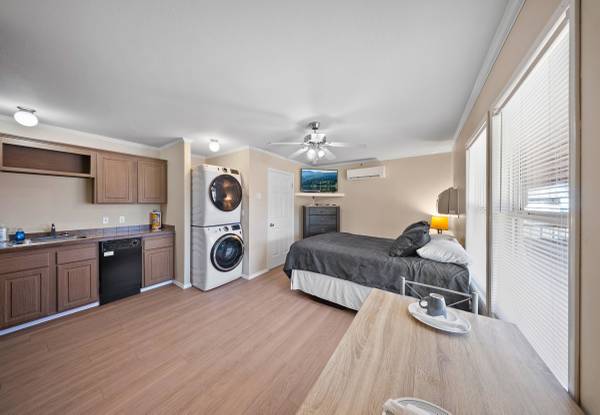
Applying a 3% option fee, a figure inside the sourced 1 to 7% range, to the Census-reported median home value produces a concrete two-year walkthrough. The rent-premium and credit figures below are illustrative and drawn from a brokerage-published guide rather than Census data; get both numbers in writing before signing any real contract.
| Line item | Amount | Basis |
|---|---|---|
| Median owner-occupied home value, Baton Rouge | $234,700 | Census QuickFacts, 2020-2024 ACS 5-year estimate |
| Option fee at 3% | $7,041 | Within Redfin’s sourced 1 to 7% range |
| Rent premium above market (illustrative) | $300/month | Within the $200 to $500 range reported by a brokerage-published rent-to-own guide |
| Rent credit at 25% of the premium | $75/month, $1,800 over 24 months | Illustrative allocation; the actual percentage is set contract by contract |
| Combined credit toward purchase after 24 months | $8,841 | Option fee plus accumulated rent credit |
| Adjusted price if the buyer closes | roughly $225,859 | $234,700 minus $8,841 |
How much of my rent actually counts toward the price?Only whatever percentage the contract states, and only for the portion labeled a credit. A $1,200 monthly rent with a $150 credit still leaves $1,050 as ordinary rent with no equity value, even though the whole payment is due monthly.
Is this the right move for you right now
| Your situation | Fits rent-to-own | Better alternative if it doesn’t |
|---|---|---|
| Credit score already in the FHA-qualifying range | Weak case, you’d pay a premium for time you don’t need | An FHA loan, 3.5% down at qualifying credit |
| Rebuilding credit with a documented 1 to 3 year timeline | Reasonable case | Pair the lease period with a HUD-approved counseling program |
| No savings at all, even for an option fee | Weak case | Louisiana Housing Corporation down-payment assistance programs |
| Seller can’t produce a clean title or mortgage payoff statement | No case, regardless of contract type | Walk away; no contract structure fixes a title problem |
| Need to relocate for work within 2 years | Risky specifically under a lease-purchase | A standard lease, to avoid a binding purchase obligation |
If the seller still owes money on their own mortgage, Louisiana law requires a written guarantee from the mortgage holder to release the property once the buyer finishes paying, before the seller may lawfully offer it by bond for deed at all. Selling an encumbered property by bond for deed without that guarantee is a criminal violation, not just a contract defect.
How to tell a legitimate deal from one that isn’t

- Ask for the mortgage payoff statement, not just a verbal assurance. A seller who won’t produce one may not own the property free and clear.
- Confirm which of the three contracts you’re signing, by name, in the document itself. “Rent-to-own” alone in a title is not a contract type.
- Check whether a bond for deed is recorded. Louisiana law requires recordation in the parish conveyance records; an unrecorded bond for deed may not protect you against the seller’s creditors.
- Get the option fee and rent-credit percentage in writing, as dollar figures.
- Route the deal through a title company before paying anything nonrefundable, per the routing section below.
What if I lose my job partway through the lease term?Under a lease-option, you can typically walk away and lose the fee and credits, but nothing more. Under a lease-purchase, refusing or failing to close can expose you to a breach-of-contract claim for damages. A job loss on its own doesn’t change which contract type you’re in, so check your specific agreement’s default clause rather than assuming the bond-for-deed refund protections above apply automatically.
Who to involve, and when
A rent-to-own deal touches on financing, escrow, and title all at once, and a single real estate agent’s commission incentive doesn’t cover all three.
- A title company, before you pay any option fee, to run a lien and ownership check.
- A Louisiana-licensed attorney, to confirm whether the contract is a lease-option, lease-purchase, or bond for deed, since the consequences differ this much.
- A licensed bond for deed escrow agent, if the contract is a bond for deed and the property carries a mortgage; Louisiana requires this role to be licensed by the state Office of Financial Institutions.
- A mortgage broker, well before your option period ends, to confirm you’ll qualify to close when the time comes.
The Louisiana Housing Corporation, at 2415 Quail Drive in Baton Rouge, runs HUD-approved homebuyer counseling and can review your finances against a realistic purchase timeline before you commit to a multi-year lease.
Do I need a real estate agent for this?Not necessarily. Agents earn less on lease-option deals than on a standard sale, so their incentive to walk you through one carefully is weaker. A title company, an attorney, and a mortgage broker cover the parts of the transaction that carry the real risk.
Where to actually find and vet a Baton Rouge listing
Search directly for “bond for deed” alongside “rent-to-own” in Baton Rouge listings; sellers who use the correct legal term are more likely to have drafted the contract properly. Cross-check any address a listing site gives you against the East Baton Rouge Parish Assessor’s public records before contacting the seller, to confirm who currently holds title. Treat any listing site’s promise of “no credit check, no bank” as a description of the seller’s process, not a guarantee of the deal’s legality.
Comments