
What Counts as a Luxury Home
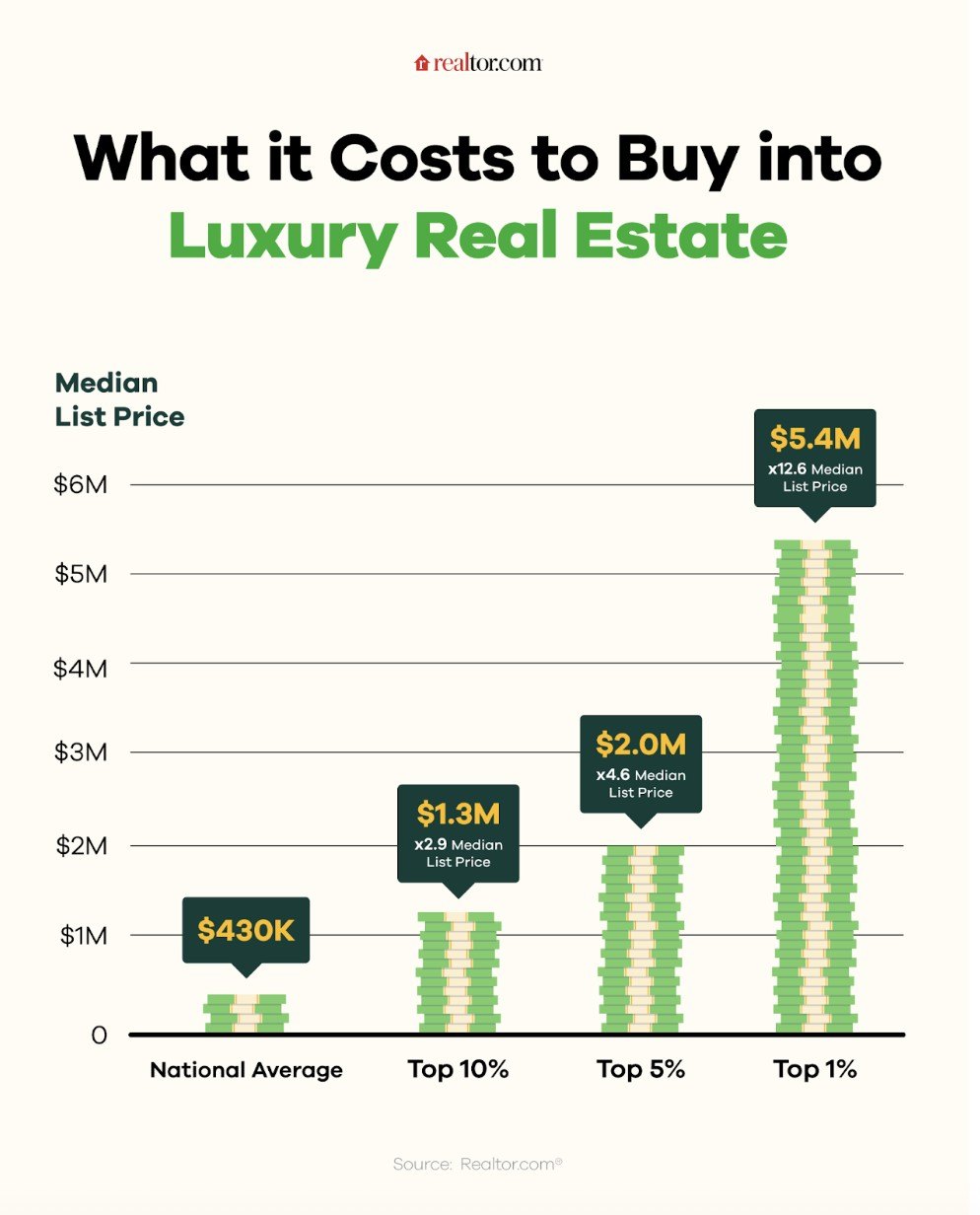
No single dollar figure defines “luxury” anywhere in the U.S. Both national bodies that publish luxury data anchor the term to a local percentile instead: NAR’s consumer research classifies luxury as the top 10% of listings by price in a given market, and the Institute for Luxury Home Marketing uses the same top-10% rule with a $500,000 floor underneath it, so a top-10% home in a cheap market still doesn’t count if it prices under half a million. Redfin, which tracks the segment separately from the general market, reported a median U.S. luxury sale price of $1.37 million for the three months ending May 31, 2026, up 4.7% year over year, more than three times the 1.5% gain in non-luxury prices over the same period.
The percentile rule is also why the same price tag means different things in different places. Miami-Dade County defines its luxury threshold at the top 5% rather than the top 10%, which lands at $3.4 million, per the Compass National Insights Report; Aspen’s top-1% ultra-luxury threshold is $59.2 million, per Realtor.com’s March 2026 Luxury Housing Report, roughly ten times the national top-1% figure. A buyer comparing listings across metros needs to know which percentile a given source is using before treating any single number as a rule.
Is there an official price that makes a home “luxury”? No federal or industry-wide dollar figure exists. The two bodies that publish national luxury data anchor the definition to the top 10% of a given local market by price rather than a fixed number, which is why a $1.5 million home is entry-level luxury in Naples and far below the luxury floor in Aspen.
What Luxury Costs by Market
Luxury pricing varies by more than a factor of ten between the markets below, and Redfin’s national tracking shows the gap widening: the median U.S. luxury sale price rose 4.7% year over year to $1.37 million during the three months ending May 2026, more than triple the 1.5% gain in the non-luxury segment.
| Metro | Threshold or median | Basis / source | Recent movement |
|---|---|---|---|
| Naples–Marco Island, FL | $1.5M (local floor) / $3.5M (metro threshold) | NABOR / Realtor.com | Luxury homes sold 23.5% faster year over year in late 2025 (Realtor.com) |
| Miami-Dade, FL | $3.4M (top 5%) | Compass National Insights Report, May 2026 | $1M+ single-family sales hit a record 55% of 2025 dollar volume |
| Aspen, CO | $17.5M single-family median (2025) | Aspen Board of Realtors / Estin Report | Median rose to $22.75M in Q1 2026 on a concentration of $20M+ sales |
| Greenwich, CT | $2.5M median (3 mo. ending 5/26) | Redfin | Up 21% year over year, selling in roughly 27 days |
| Columbus, OH | Midwest comparison point | Redfin luxury tracking | New luxury listings up 12.4% year over year, the third-fastest of any metro tracked |
Naples makes the definitional problem concrete: two organizations covering the same county publish luxury floors two million dollars apart, because NABOR anchors to a fixed local benchmark while Realtor.com applies a top-percentile formula across the wider metro. Anyone comparing these five markets has to check which basis a given number uses before treating it as comparable to another metro’s figure.
Where to Search: Comparing the Major Listing Portals

The major portals split by inventory type, not just by brand, and comparing them changes what a search actually returns.
| Portal | Inventory type | Practical price floor | Best used for |
|---|---|---|---|
| Zillow’s U.S. luxury search | Live MLS feed, price-sorted, uncurated | None stated; land parcels rank alongside houses by price alone | Broadest, freshest view of what’s publicly listed right now |
| JamesEdition | Curated marketplace, agent-submitted | Effectively starts in the high six figures per its published range | Comparing curated inventory internationally, not just in the U.S. |
| LuxuryRealEstate.com | Global brand and agent network | No price filter on the main browse view; listings skew global | Finding an agent through brand or destination rather than price |
None of the three names or compares the others, worth knowing before treating any single portal as complete: a buyer checking only Zillow never sees JamesEdition’s curated high end, and one checking only JamesEdition misses most of the publicly listed inventory that never gets submitted to a curated marketplace at all.
Getting Financing-Ready Before You Search
Above $832,750 in most U.S. counties, or above $1,249,125 in federally designated high-cost areas, a mortgage moves out of conforming territory and into jumbo underwriting, per the Federal Housing Finance Agency’s 2026 loan limits. That figure is a lending-market threshold, not a legal requirement to buy any specific home; many luxury sellers independently require a proof-of-funds letter or lender pre-qualification before scheduling a showing, regardless of how the purchase will be financed.
| Loan limit category | 2026 baseline | 2026 high-cost ceiling |
|---|---|---|
| Most U.S. counties | $832,750 | $1,249,125 (150% of baseline) |
| Alaska, Hawaii, Guam, U.S. Virgin Islands | $1,249,125 | $1,873,675 |
Cash concentrates exactly where this table’s ceiling numbers are highest: roughly 60% of Naples purchases closed all-cash in late 2024, over 70% of $1M+ Miami-Dade condo purchases were all-cash in 2025, and 65% to 70% of Aspen transactions close in cash, all well above the 27% national cash share NAR reported for March 2026. A buyer planning to finance in any of these three markets should expect fewer financed comparables to benchmark against.
Do I need cash to buy a luxury home? Not always, but a jumbo loan means larger reserve and down-payment requirements than a conforming loan, and it makes an offer take longer to firm up than an all-cash bid. In Aspen and Miami-Dade specifically, where 65% or more of transactions already close in cash, a financed buyer’s contingency period is competing directly against sellers used to fast, cash-only closings.
Common Mistakes at This Price Tier
The most common pricing mistake at this tier is treating a standard comparable-sales approach as reliable once inventory thins to a handful of active listings, common above $5 million in most U.S. metros. NABOR’s days-on-market figures make the second mistake visible: the $5 million-plus Naples segment averaged 140 days on market against a 74-day full-market average, and homes priced past what the thin comp set will support are the ones filling that gap. Sellers who price to the last comparable sale rather than to current demand are the ones stuck waiting.
Off-Market and Unlisted Luxury Inventory
Portals only show what gets submitted to them, and a policy set by the National Association of Realtors controls when that submission has to happen. NAR’s Clear Cooperation Policy, in effect since 2020, requires agents to submit a property to the MLS within one business day of marketing it publicly. A March 2025 amendment, “Multiple Listing Options for Sellers,” added a “delayed marketing exempt” category: a seller can file with the MLS, keeping the listing visible to cooperating agents, while postponing its syndication to public portals for a period the local MLS sets.
A HousingWire-reported analysis of more than 700,000 sales found the pricing premium once associated with pocket listings fell by roughly 73% after Clear Cooperation took effect, from about 3.3% to a statistically insignificant 0.9%, for typical homes. The same research found the luxury-tier premium still runs above 8%, against roughly 1.7% for typical homes, a measurable reason the practice persists at the high end even after the policy closed off most of the advantage elsewhere.
One recent transaction shows what a portal search alone misses: 645 Willoughby Way on Red Mountain in Aspen closed at $37 million, $4,034 per square foot furnished, on June 1, 2026, tracked in a local brokerage’s closed-sales report before it ever surfaced in a live portal listing.
How do I see off-market luxury listings? Ask a local buyer’s agent directly. NAR’s 2025 delayed-marketing policy lets sellers hold a listing back from public portal syndication while it still exists inside the MLS for cooperating agents, so an agent active in that market can often show a listing weeks before Zillow or Redfin would ever display it.
Timing: How Long Luxury Listings Sit

Luxury doesn’t mean slower everywhere: Greenwich, Connecticut luxury-tier homes sold in about 27 days over the three months ending May 2026, faster than the 41-day national median NAR reported for March 2026, while Naples’ $5 million-plus segment averaged 140 days and Aspen homes averaged 124 days over a comparable recent window.
Greenwich’s 27 days and Aspen’s 124 days are both real, and neither one describes the other market. Greenwich’s speed reflects tight inventory and strong local demand; Naples and Aspen’s longer timelines reflect thinner buyer pools at the very top of those specific markets. A seller in a fast-moving luxury pocket who prices as though they’re in a 140-day market will leave money on the table, and a seller in a 140-day market who expects a 27-day sale will misjudge their own negotiating position.
Do luxury homes sell faster or slower than average? It depends on the metro, and the numbers vary widely: Redfin’s national data shows luxury pending sales up 5.2% year over year, the fastest pace since December 2024, with some markets like Greenwich selling faster than the general market while thin-inventory segments in Naples and Aspen still average well over 100 days on market.
Comments