
Conway vs. Myrtle Beach in 2026: what the numbers actually show

| Metric | Conway | Myrtle Beach | Source |
|---|---|---|---|
| Median sale price, 3 mo. ending May 2026 | $280,000 | $266,000 | Redfin |
| Median sale price, May 2026 (single month) | $319,880 | – | Movoto |
| Days on market | 110 | 118 | Redfin |
| Median age of resident | 35.6 | 45.7 | Century 21 McAlpine |
Conway skews roughly a decade younger and, on the most current three-month window, no longer prices meaningfully below Myrtle Beach.
Cost of living and property taxes, with the real numbers

Two trackers give different answers, and both are legitimate. BestPlaces scores Conway at 90.4, or 9.6% below the U.S. average. Salary.com’s 2026 calculator puts Conway 14% below the national average, driven by housing costs running 32.6% under the national figure.
| Category | Conway vs. national average | Source |
|---|---|---|
| Housing | 32.6% lower | Salary.com, 2026 |
| Food | 23.3% lower | Salary.com, 2026 |
| Energy, transportation, healthcare combined | 20.2% lower | Salary.com, 2026 |
| Overall index | 9.6% to 14% lower | BestPlaces / Salary.com |
For a primary residence, South Carolina taxes at a 4% assessment ratio; a second home, rental, or investment property is taxed at 6%. A representative Horry County millage breakdown – county 56.2, school 128.1, fire 23.2, waste management 8.7, from a prior tax-year example – shows how those pieces stack, though the exact mills reset annually and by taxing district.
| Classification | Assessment ratio | Approx. effective rate | Notes |
|---|---|---|---|
| Owner-occupied primary residence | 4% | ~0.33% of value | Must file for Legal Residence after closing – it is not automatic |
| Second home / rental / investment | 6% | Roughly 1.5 to 1 against the primary rate | No school-operating exemption |
| 65+, blind, or disabled homestead | 4% plus $50,000 value deduction | Below the standard 4% figure | Separate application at the Auditor’s office |
Which cost-of-living number for Conway is correct – 9.6% or 14% below the national average? Both are real, from different baskets. Treat 14% as the housing-weighted figure and 9.6% as the broader multi-category index; neither should be quoted alone as “the” number.
Flood zones and insurance: what “check your zone” actually means

The Waccamaw River set a record crest of 21.16 feet during Hurricane Florence in September 2018, more than three feet above the prior Hurricane Matthew record of 17.9 feet, flooding roughly 1,000 homes and businesses near the river; Horry County later tallied 361 damaged homes in Conway alone and about $49 million in county residential damage. That history sits along the river corridor and its tributaries specifically. The City of Conway’s Building Department and the FEMA Flood Map Service Center are the two places to pull an address-level determination and Base Flood Elevation before writing an offer. Flood insurance is federally required only when a structure sits in the mapped Special Flood Hazard Area with a federally backed loan attached; outside that zone it’s optional, though standard homeowners’ policies exclude flood damage everywhere in the county regardless.
Do I need flood insurance if my address isn’t inside the mapped Special Flood Hazard Area? Not by law, but standard homeowners’ insurance still won’t cover flood damage anywhere in the county, so a low-cost preferred-risk policy is worth pricing even outside the mapped zone.
Neighborhoods and price bands
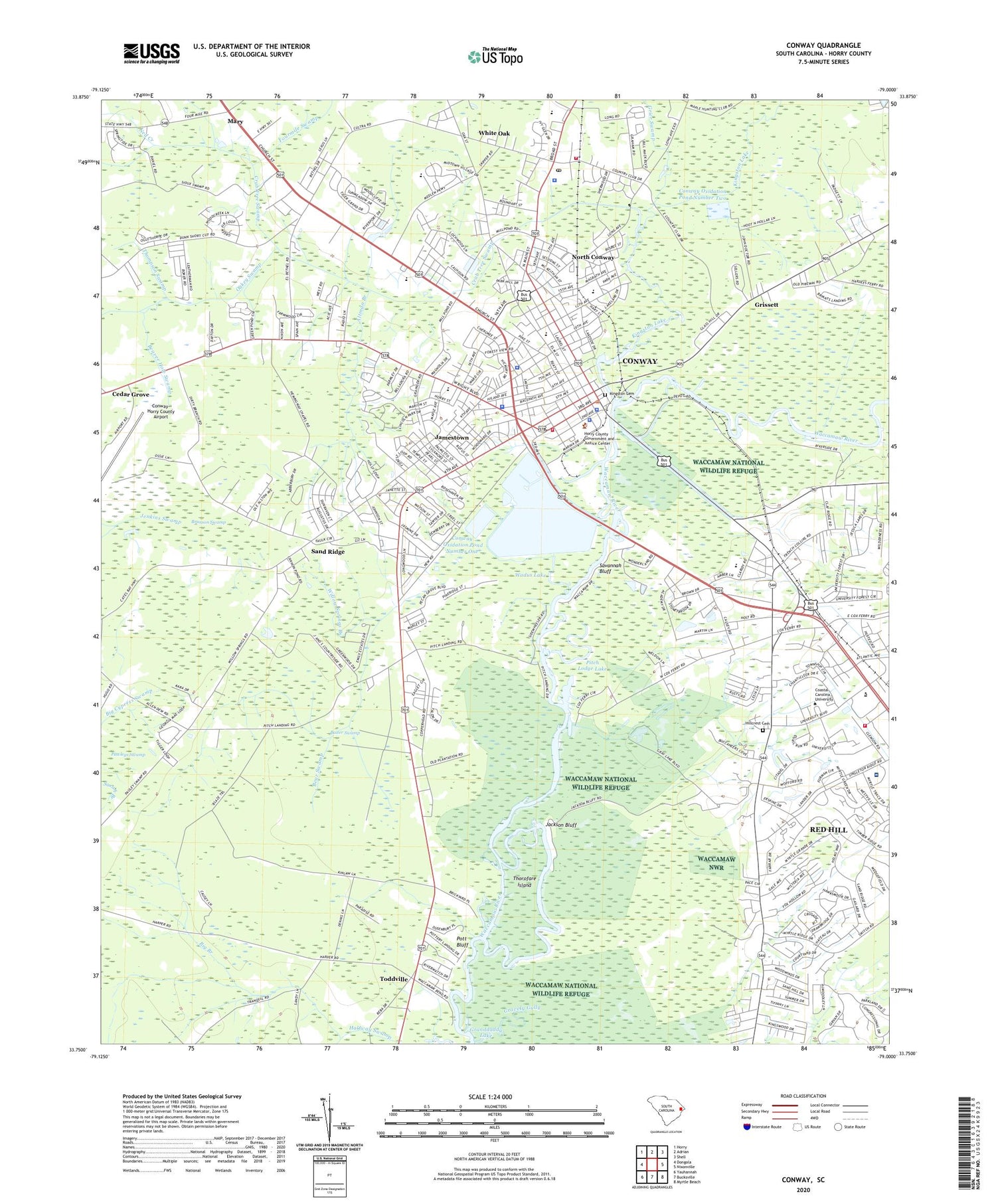
Historic downtown
Conway’s historic core sits closest to the Waccamaw River and carries the deepest documented flood history of any sub-area in this guide. It also carries the oldest housing stock, so inspections should weigh foundation type and prior flood repairs as heavily as square footage.
New subdivisions along the growth corridors
Highway 501, 544, and 90 carry most of Conway’s newer construction, generally on higher ground away from the river. That reduces flood exposure but adds commute-band tradeoffs: distance to the beach runs from roughly 15 to 30 minutes depending on which corridor a subdivision sits on.
Farmland and acreage
Outlying parcels toward Highway 701 and the Georgetown County line offer larger lot sizes at a discount to subdivision pricing, generally with septic and well service instead of municipal utilities – a due-diligence item unrelated to flood risk that changes the closing checklist just as much.
| Area | Flood exposure | Distance to beach | Typical stock |
|---|---|---|---|
| Downtown historic district | Partially inside mapped SFHA – confirm by parcel | ~20 to 25 min | Pre-1960s, renovated and original |
| Hwy 501/544 growth corridor | Typically outside mapped SFHA – confirm by parcel | ~15 to 20 min | 2015-present construction |
| Hwy 90/701 outlying areas | Typically outside mapped SFHA – confirm by parcel | ~25 to 30 min | Larger lots, septic/well common |
Schools and family fit
Conway sits inside Horry County Schools, which reports roughly 10 elementary, 8 middle, and 8 high schools serving the wider Conway area, with an average GreatSchools rating around 5 of 10 across the city’s public schools. Attendance boundaries shift as new subdivisions are added and are not fixed by neighborhood name.
How do I find which Horry County school serves a specific Conway address? Use the Horry County Schools attendance-zone locator directly; boundary lines change with new development, and a realtor’s verbal answer can be a year out of date.
Buying in Conway: process and mistakes to avoid
The most common and costly mistake is checking flood risk at the city level instead of the parcel level, which produces both false alarm on high ground and false comfort on low ground near a tributary. A second is assuming legal-residence tax status transfers with the deed – it doesn’t; the buyer must file with the Assessor after closing or the property defaults to the 6% non-owner rate on the next bill. A third is treating HOA rules as uniform across Conway subdivisions when covenant strictness, rental caps, and fee levels vary building by building.
What’s the single costliest mistake buyers make in Conway? Skipping the parcel-level FEMA check and relying on a general sense that “Conway floods” or “Conway doesn’t” – the record 2018 crest and the current mapped zones both run by specific address, not by city reputation.
Selling in Conway: what’s different right now

Every regional forecast for 2026 describes a buyer’s market along the Grand Strand, with rising days-on-market and a growing share of price reductions. A Conway seller competing against that backdrop should expect longer marketing time than in 2024 and should price to current comparables rather than last year’s appreciation curve.
Investing in Conway: rental demand and short-term-rental rules
Coastal Carolina University’s enrollment topped 11,000 students and set a record for the third straight year, while on-campus housing tops out around 5,400 to 5,500 beds – overflow demand routes into off-campus apartments along Highway 501 and 544 every fall. That’s a structural, recurring long-term-rental driver near campus, distinct from the seasonal, tourism-driven short-term-rental market that dominates coastal Horry County.
On the short-term side, Conway itself has no published citywide STR ordinance; operators rely on a standard business license, zoning confirmation, and state accommodations-tax registration. That’s a lighter regulatory load than Myrtle Beach, which restricts STRs to specific zones and has capped conversions from short-term to long-term use to protect lodging-tax revenue. An investor should still confirm parcel-level zoning and any HOA rental cap before assuming either use is available.
Is Conway a good rental or investment market? The strongest documented driver is CCU’s enrollment growth outpacing on-campus housing, which supports long-term student rental demand near campus; the short-term-rental case is thinner and depends entirely on the specific property’s zoning, since Conway lacks a dedicated STR ordinance to point to.
Is Conway right for you?

- Buy here if you want a lower entry price than coastal Horry County historically offered – confirm that against current comps rather than the older gap.
- Rent to students if the property sits within a short commute of the CCU campus corridor, given the documented bed shortfall.
- Avoid assuming guaranteed short-term-rental income without confirming zoning first, since no citywide STR framework exists to fall back on.
- Budget for the 6% non-owner assessment ratio if this won’t be a primary residence, and a flood-insurance quote regardless of mapped zone.
Comments