
Where and what Big Canoe is
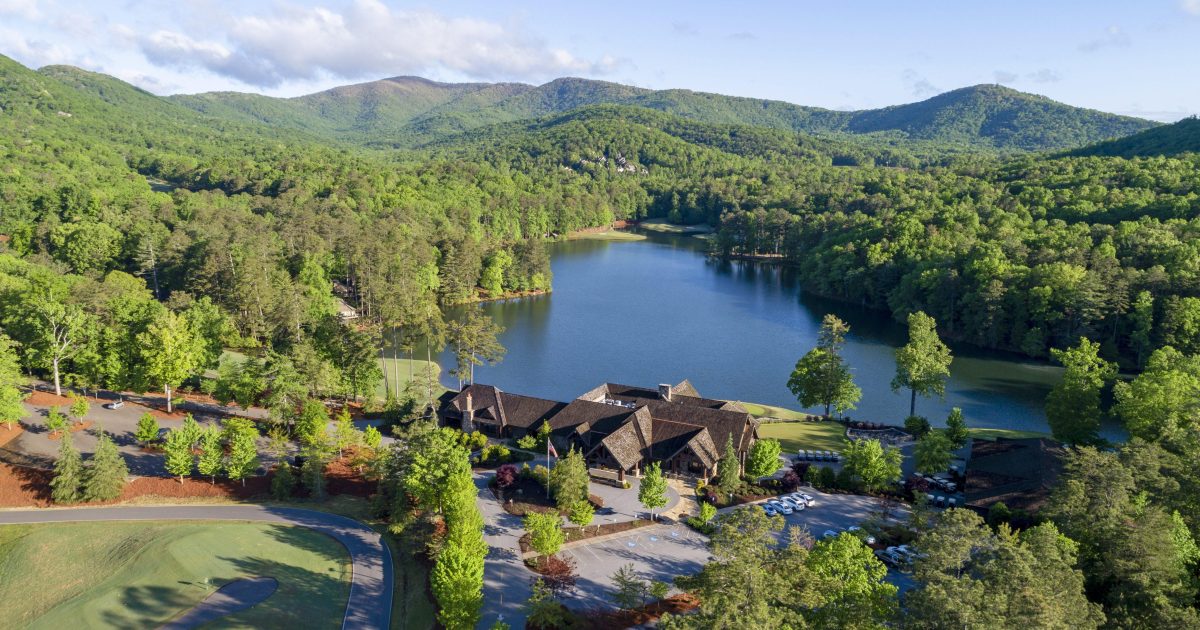
Big Canoe is a private, gated community in the Blue Ridge foothills, spanning Pickens and Dawson counties roughly an hour north of Atlanta. It was founded in 1972 and covers about 8,000 acres around three lakes, a golf and tennis club, and 20-plus miles of trails. That’s the whole footprint most buyers need before the numbers below.
Current market snapshot

Two independently sourced snapshots from May 2026 point the same direction. FMLS-fed data compiled by HomesByMarco shows the median sale price climbing from $724,000 to $834,500 year over year, a 15.3% jump, alongside 66 active single-family homes averaging $780,402 in list price and 41 available lots averaging $91,120. Movoto’s own market-trends page for the same month shows a median list price of $775,000, $242 per square foot, and homes moving in 66 to 68 days, down from 86 days a year earlier. Both point to a market that tightened over the past year rather than one that’s cooling.
Is Big Canoe currently a buyer’s market or a seller’s market? Neither data set from May 2026 supports buyer’s-market framing: days on market fell year over year and the median sale price rose double digits. Sellers currently have the leverage, and buyers should expect competition on well-priced listings.
What it costs to own here
The one-time and recurring costs come from three separate line items, and no single public source reconciles all three against a current date.
The mandatory monthly POA assessment funds roads, public safety, and the lakes; it is separate from any amenity membership. A community-paper account of the November 2025 board meeting reported the board approved the smallest operating-assessment increase in seven years for 2026: $15 a month, a 3.75% rise, with zero increase to the separate capital assessment. Working back from that percentage puts the prior year’s homeowner operating assessment near $400 a month, up from a $356-a-month combined figure a local brokerage published for 2023, consistent with a slow multi-year climb rather than a spike. The POA has not published an itemized 2026 dollar total in a source this research could confirm, so treat the derived roughly $415-a-month operating figure as an estimate to verify directly with the POA before closing, not a quoted rate.
| Cost type | Current figure | Trend / notes | Source type |
|---|---|---|---|
| Monthly operating assessment (homeowner) | ~$400/mo (2025 base), +$15 (3.75%) for 2026 | Smallest increase in 7 years; funds payroll, safety, roads | Community newspaper reporting POA meeting |
| Monthly capital assessment | No change for 2026 | Funds capital projects (dam, spillway, equipment) | Same source |
| One-time initiation, 2023 published rate | $3,500 at closing (homeowner) or at CO (lot owner) | A related Capital Contribution Fee rose to the covenant maximum for 2026 | Brokerage page (2023) plus board-meeting report (2025) |
| Average annual property tax | $3,425.91 | Community-wide average across both counties | FMLS-sourced aggregator data |
| Optional HOA/amenity fees | $28 to $4,572/mo | Depends on lot-only vs. full golf/tennis/fitness/swim membership load | FMLS-sourced aggregator data |
The spread between the cheapest and most expensive line on that table is the real budgeting trap: a lot owner paying $28 a month bears little resemblance to a full golf-and-tennis household paying into four figures monthly, and the list price alone won’t tell you which one you’re buying into.
What happens if the assessment goes up after I close? You keep paying the new rate. Assessments are set annually by the POA board and apply to every owner in that category, whether you closed in 2020 or next month.
Buying into a private, gated association
Closing on a standard subdivision lot and closing inside Big Canoe aren’t the same transaction. Beyond the purchase price, the POA charges a Capital Contribution Fee to new buyers, and the board raised that fee to the maximum allowed under the community’s covenants for 2026, a dated example of a cost buyers researching only the list price would miss. The same November 2025 meeting raised the annual Leasing Administration Fee, the registration charge tied to renting out a property. That tells prospective investors two things: short-term and long-term leasing is permitted, and it carries a POA-administered registration cost that rises on its own schedule, independent of mortgage or HOA math.
In late May 2026, Harry Norman’s live Big Canoe listing feed carried an active 5-bedroom, 6,138-square-foot home listed at $2.2 million next to dozens of buildable lots averaging roughly $91,000. That spread shows how differently “buying in Big Canoe” plays out depending on whether the purchase is a finished luxury home or a bare lot for a future build.
Is there a special fee just for buying property here that a standard closing wouldn’t have? Yes. Beyond typical closing costs, new owners pay a POA Capital Contribution Fee, set at the covenant maximum starting in 2026, on top of any real estate commission and county transfer tax.
Rules that affect buyers: the lakes
Big Canoe’s three lakes are private property owned and administered by the POA: they are not public water managed day to day by a state agency, and the rules reflect that. Only electric-powered vessels are allowed; internal combustion motors are prohibited outright. Dock and boat-rack space at the marina belongs to the POA and is assigned by permit, transferable only through the Marina office, so it isn’t part of a lakefront lot’s title the way a private dock might be elsewhere. Fishing requires a permit for anyone 13 or older, carries a four-trout daily limit, and prohibits releasing caught trout back into the lake.
| Rule | Practical implication for buyers | Source |
|---|---|---|
| Electric motors only; gas motors prohibited | A lakefront listing doesn’t come with the option to run a standard gas outboard | bigcanoepoa.org, Marina page |
| Dock/rack space is POA property, permit-assigned | Owning lakefront land doesn’t guarantee a dock; check current permit availability before assuming one | bigcanoepoa.org, Marina Equipment page |
| Fishing permit required, age 13+; 4-trout daily limit | Recreational fishing has enforced limits, not an informal honor system | bigcanoepoa.org, Marina Rules & Guidelines |
Stating the practical effect of each rule, not just the rule itself, is what turns a bullet list into something a buyer can act on before making an offer.
Can I run a motorboat or jet ski on the Big Canoe lakes? No. Only electric-powered watercraft are permitted; gas-powered boats and personal watercraft such as jet skis are not allowed on any of the three lakes.
Who Big Canoe fits – and who it doesn’t
| Buyer type | Fit signal | Disqualifying signal |
|---|---|---|
| Full-time retiree wanting low-maintenance mountain living | Amenity infrastructure (golf, fitness, dining) is already built and staffed | Discomfort with a board that sets assessments annually without a pre-closing vote for the buyer |
| Weekend or seasonal second-home buyer | Roughly 40% of residents already live there part time, so the culture supports it | Paying full operating assessments year-round regardless of occupancy |
| Rental-income investor | Leasing is permitted and administratively registered | The 2026 Leasing Administration Fee increase adds a recurring cost a simple cap-rate calculation from the list price would miss |
| Buyer wanting a private lakefront dock under full personal control | Marina slips are available to property owners | Docks are POA-permitted and assigned, not a private asset that transfers automatically with the lot |
| Buyer planning to run a gas-powered boat or jet ski | None found | The electric-only rule applies to every owner on every lake, with no exception in the sourced rules |
Governance and resale risk
Two data points matter here, and they’re rare because they surface only in local reporting, not brokerage marketing. First, the 2025 Board of Directors election failed to reach its required 35% quorum: only 1,883 of 6,222 eligible votes were cast, so two sitting directors stayed on past their terms pending a special election. That’s a governance-participation signal worth weighing before assuming annual assessment increases get close owner oversight. Second, a buyer purchasing a bare lot specifically for resale should note that lot values and home values don’t necessarily move in lockstep inside a private association where assessments rise on their own schedule, independent of the broader housing market’s direction.
Comments