
What Kind of Place Is Virginia Beach?
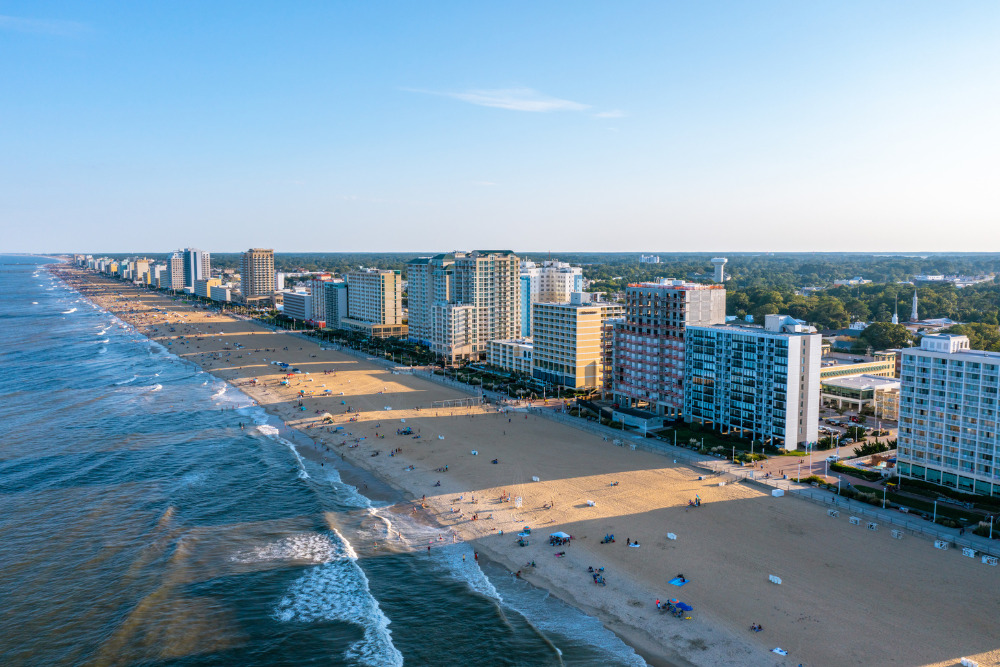
Two different things get called “Virginia Beach.” One is the Oceanfront: a three-mile boardwalk strip of hotels and restaurants. The other is the city that contains it, which stretches 497 square miles from that boardwalk to farmland near the North Carolina line. Census Bureau area measurements put 249 of those square miles on land and 248 in water, so nearly half the city’s official footprint is Chesapeake Bay, the Atlantic, and connecting rivers, not the beach itself.
The city is also legally an independent city, a category found almost nowhere outside Virginia. Under Article VII of the Constitution of Virginia, a city here is a separate legal jurisdiction from any county, even when it’s fully surrounded by one. In practice that means Virginia Beach runs its own courts, its own school division, and its own social-services agency, and residents pay city taxes only, with no county layered on top, a structure Civics Education Virginia describes as leaving cities and counties as completely separate governments. Of the 41 independent cities in the United States, 38 are in Virginia; outside the state, only Baltimore, St. Louis, and Carson City share the arrangement.
What’s the difference between the Oceanfront and Virginia Beach the city? The Oceanfront is a roughly three-mile resort district within the city. Virginia Beach the city extends about 20 miles further south and west, into suburban neighborhoods and farmland the Oceanfront visitor never sees.
Population, Size, and How the Rankings Compare
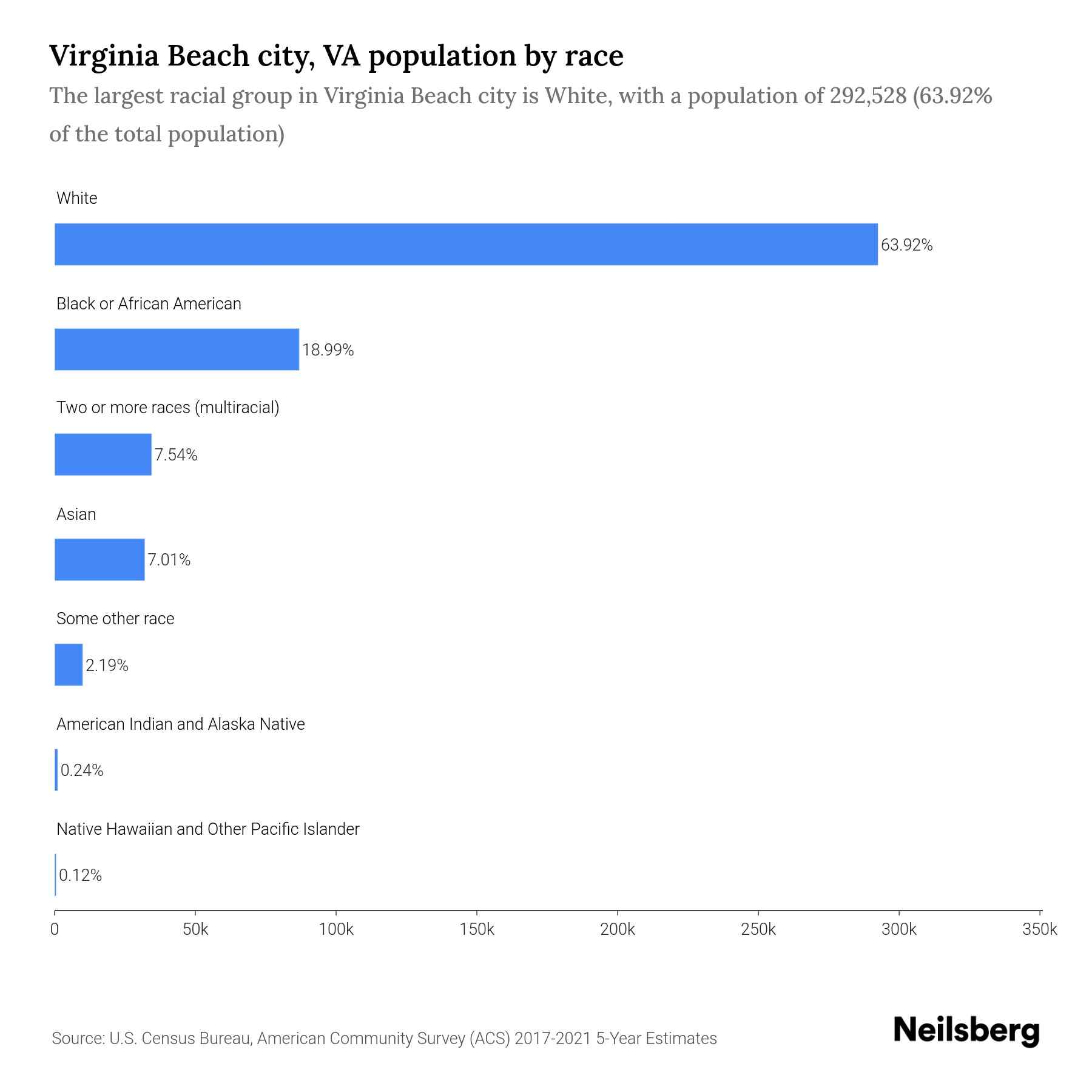
The 2020 decennial count put Virginia Beach at 459,470 residents, the 42nd-largest city in the country. The Census Bureau’s 2024 population estimate puts it closer to 453,600–456,300, a slight decline that pushes the national rank to 43rd in some current compilations. Both numbers come from the same agency; the rank moved because the underlying population edged down, not because two sources disagree.
| Metric | Current figure | Source / date | Discrepancy note |
|---|---|---|---|
| Population | ~453,600–456,300 | U.S. Census Bureau Population Estimates Program, 2024 vintage | Different vintage-year releases (2023, 2024) give figures a few thousand apart; none are wrong, they’re just different snapshots |
| National rank | 42nd (2020) to 43rd (2024 est.) | Census 2020 decennial; Census-derived city rankings | Rank shifted with a small population decline since 2020, not a sourcing conflict |
| Land vs. water area | 249 sq mi land / 248 sq mi water | U.S. Census Bureau Gazetteer Files | Usually reported as a flat “497 square miles,” which hides that half is water |
| Violent crime, 2024 | 420 offenses (92 per 100,000) | VBPD / FBI UCR data, released Feb. 2025 | Some real-estate data sites publish a separate proprietary “crime index” with no visible methodology; treat that figure with caution |
The land/water split matters more than the raw acreage number: a city whose “size” is misread as all buildable land will misjudge how concentrated its actual neighborhoods are.
The Neighborhoods: Which Part of the City Are You Asking About?
Virginia Beach was formed in 1963 by consolidating the small original city with all of Princess Anne County, which is why its geography still reads as a patchwork of very different areas rather than one uniform place.
| Area | Verified character | Source |
|---|---|---|
| Sandbridge | Secluded barrier-beach strip, about 5 miles of shoreline, adjoining the Back Bay National Wildlife Refuge to the south | Refuge boundary and shoreline geography, city/refuge planning documents |
| Pungo | Rural, working farmland in the city’s far south, an agricultural zone rather than a suburb | City agricultural land-use designation |
| Great Neck / Kempsville corridor | Falls within NAS Oceana’s AICUZ noise contours and Accident Potential Zones, which shape what can be built there | City Planning Dept., Lynnhaven Strategic Growth Area documents |
| ViBe Creative District | City-designated arts and small-business district adjacent to the Oceanfront | City Cultural Affairs Dept. |
| Town Center (Inland) | The city’s designated urban mixed-use core away from the beach, planned as a walkable business district | City Strategic Growth Area planning framework |
Home-price and school-rating detail for each of these areas varies enough by source that this pass couldn’t verify a single reliable figure per neighborhood; a Virginian-Pilot real-estate piece or the city’s own Strategic Growth Area plans would be the next place to check before publishing specific price ranges.
Cost of Living, Jobs, and the Commute
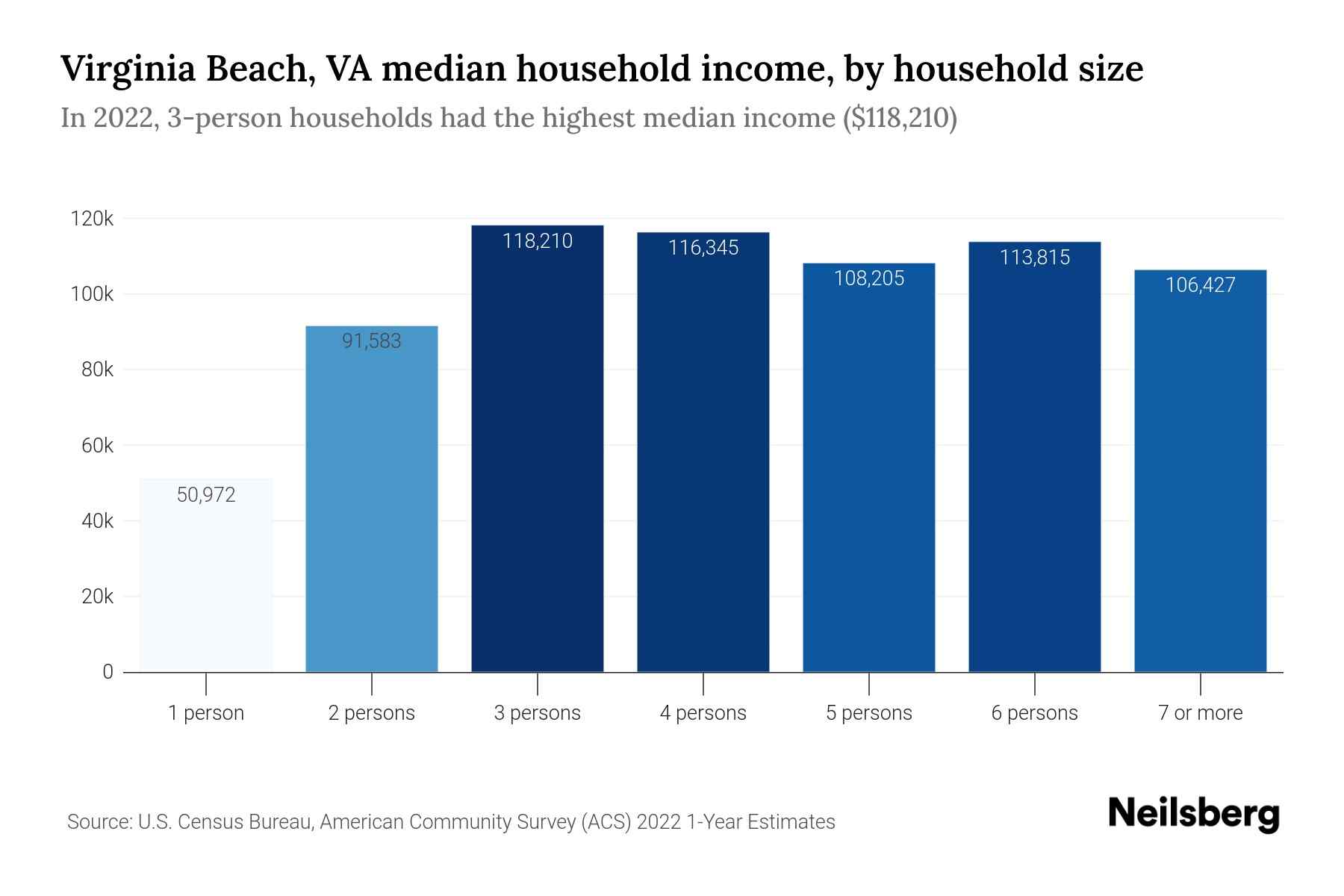
Median household income runs roughly $91,000 to $93,000 across recent American Community Survey releases, close to the statewide figure. The mean commute time was 23.4 minutes in the 2024 five-year ACS estimate, short for a city this size, largely because Oceana, the shipyards, and the tourism sector all sit inside city limits rather than requiring a drive to Norfolk.
Commuting reality
Tourism, the military (anchored by NAS Oceana and Joint Expeditionary Base Little Creek–Fort Story), and shipbuilding-adjacent defense work make up the bulk of local employment; a resident working at any of the three rarely needs to leave the city to reach work.
Climate and Flood Risk: A Standing Program, Not a Past Event
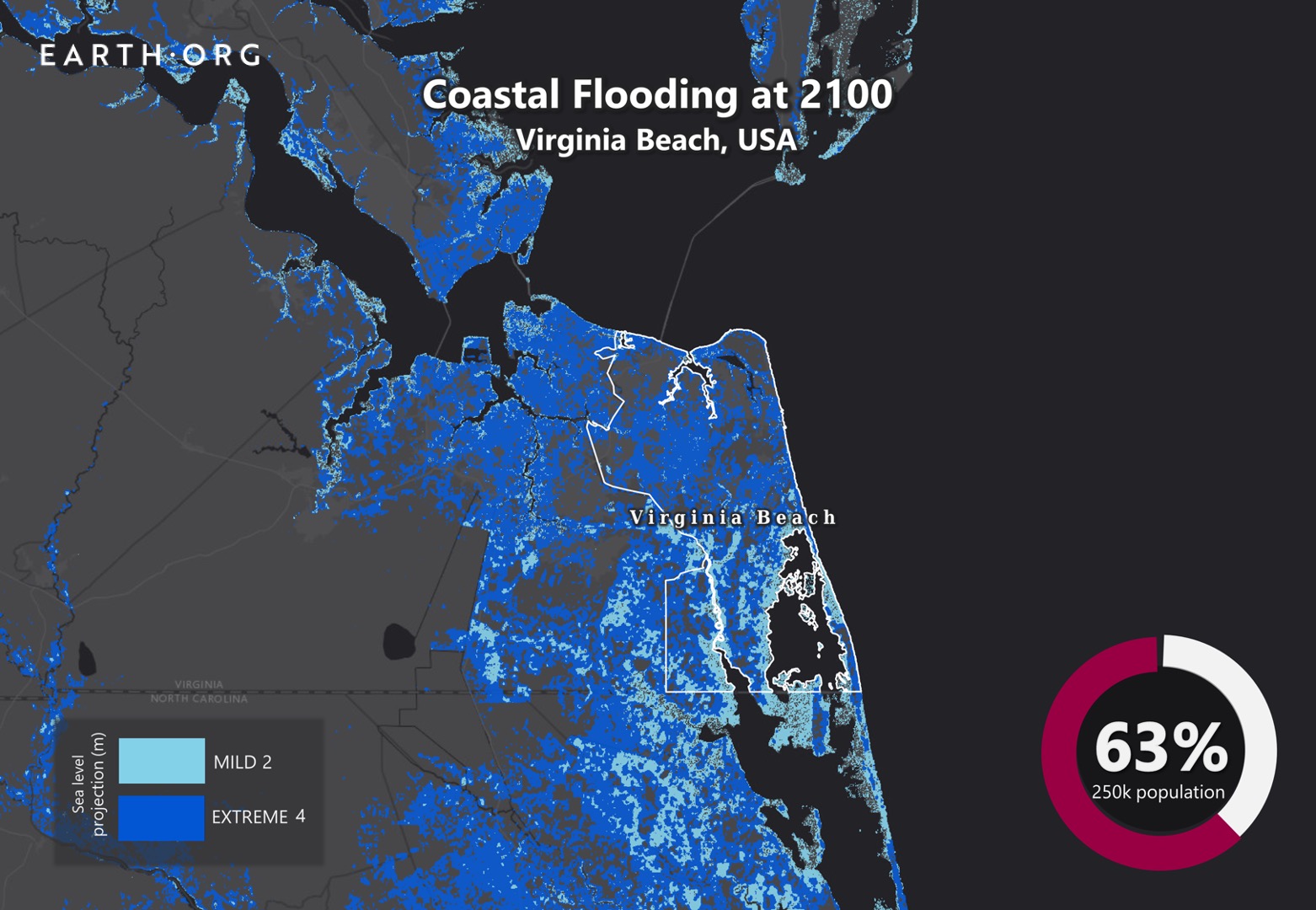
Hurricane Matthew’s 2016 flooding, which put 13 inches of rain into southern Virginia Beach neighborhoods in a single event, is the reason the city’s current flood program exists at all. In November 2021, voters approved a $567.5 million bond for 21 priority projects; by late 2025 the total program cost had grown to roughly $1.5 billion, leaving a funding gap of about $224 million against what’s currently budgeted.
| Year | Event | Impact | City response |
|---|---|---|---|
| 2016 | Hurricane Matthew flooding | 13 inches of rain, 30,000+ households affected in flood-prone neighborhoods | Triggered the stormwater infrastructure review that led to the 2021 referendum |
| 2021 | Flood-protection bond referendum | $567.5 million approved for 21 projects | “Ripple Effect” program launched, real-estate tax rate raised 4.3–6.4 cents per $100 |
| 2023 | EF-3 tornado, Great Neck | 100+ homes damaged, $15M+ in residential damage | Local state of emergency declared, city debris-removal and assessment response |
| 2025 | Program cost review | Total program cost near $1.5 billion, a $224M funding gap identified | City Council approved transferring roughly $273 million between projects to close part of the gap |
On April 30, 2023, an EF-3 tornado, the first in Virginia since 2019, tracked 4.5 miles through the Great Neck area in about five minutes. The National Weather Service found winds near 145 mph along Haversham Close, where several homes were lifted off their foundations. The city later estimated more than $15 million in residential damage, including nine homes destroyed and 36 left uninhabitable, plus roughly $3 million in damage at Fort Story. No one was injured.
Does Virginia Beach flood a lot? Recurrent flooding is concentrated in specific low-lying neighborhoods, not citywide, but it’s serious enough that voters approved over half a billion dollars in bonds for it in 2021, and the total program cost has since roughly tripled.
Government: How an Independent City Actually Works

Virginia Beach operates under a council-manager form of government: an elected City Council and mayor set policy, and an appointed city manager runs day-to-day operations. The current boundaries date to 1963, when the small original city merged with all of Princess Anne County. There is no county government layered above any of this, and there never has been since that merger.
Is Virginia Beach a county or a city? It’s a city, legally classified by Virginia as an “independent city,” which functions as a county-equivalent for federal statistics but has no county government above it.
Common Misconceptions
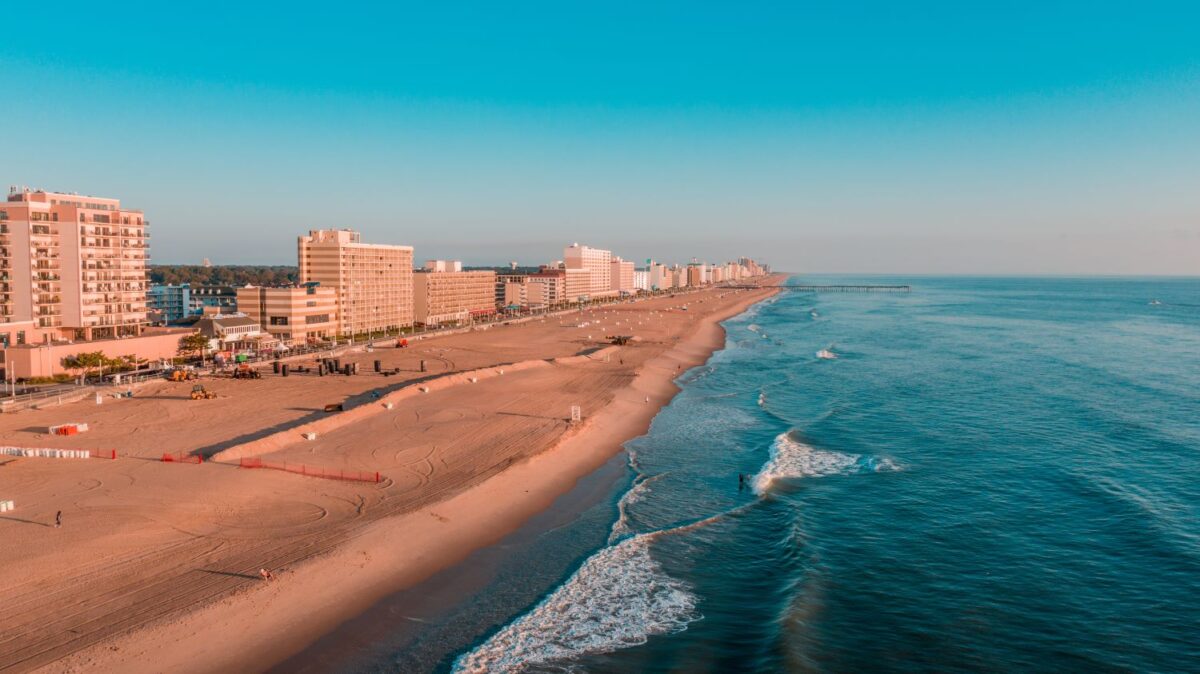
- “It’s all beach.” Roughly half the city’s official area is water, and the southern third is active farmland, not shoreline.
- “It’s part of a larger county.” It isn’t part of any county; it’s a standalone jurisdiction under Virginia’s independent-city system.
- “The population rank is a fixed fact.” It shifts by one or two positions depending on which Census vintage a source used, not because anyone is wrong.
Who Virginia Beach Actually Suits
Renters and buyers who want a short commute to a military installation or the Oceanfront tend to do well in the Great Neck, Kempsville, or Town Center areas, all inside the AICUZ-cleared parts of the city. Anyone prioritizing quiet and space over commute time gravitates toward Pungo or Sandbridge. Anyone specifically concerned about flood exposure should check a property’s flood-zone status directly with the city’s Public Works stormwater division before buying in the low-lying southern neighborhoods, since the current $1.5 billion program is still years from completion.
Comments