
Ownership Types and What They Mean for Financing
TIC
A tenancy-in-common buyer owns a percentage interest in the whole building, with an occupancy right to one unit, not a separate deed. Financing runs through fractional loans, a product offered by a small pool of specialist lenders; SirkinLaw APC traces the product’s development back to 2005. Expect 15 to 25 percent down and a rate roughly 0.25 to 0.75 percentage points above a comparable condo loan.
San Francisco broker Ruth Krishnan, discussing recent sales data, put the actual TIC-versus-condo price gap at about 5 percent, close enough that the financing premium can offset most of the discount (Ruth Krishnan / Vivre Real Estate). TICs also carry San Francisco’s strictest rent-control exposure when a unit has a tenant: an owner cannot raise rent to encourage a tenant to leave, and eviction protections are stronger than on a standard condo.
Co-op
True co-ops are uncommon in San Francisco generally, and this research pass found no sourced evidence of a meaningful co-op segment specific to Telegraph Hill. Treat that as an open research item rather than a settled fact: verify co-op prevalence with a local title company before assuming the structure applies to a specific building.
Condo
Deeded, individually titled unit with conventional Fannie Mae or Freddie Mac-eligible financing available from any mainstream lender. Highest resale liquidity of the three structures, and the baseline against which TIC pricing gets measured.
Single-family
Highest price ceiling in the neighborhood and, per one brokerage’s own listing narrative, the segment most likely to sit on a stair-only lot with no vehicle access at all.
| Ownership type | Financing | Resale liquidity | Best fit for |
|---|---|---|---|
| Condo | Conventional, broad lender pool | High | Buyers wanting the widest financing options and fastest resale |
| TIC | Fractional loan, 15 to 25% down, 3 specialist lenders | Moderate, sells via MLS but smaller buyer pool | Owner-occupants comfortable underwriting a smaller lender pool for a lower entry price |
| Single-family | Conventional | High, but price-limited pool of buyers | Buyers prioritizing space and a private lot over liquidity |
| Co-op | Not established as a meaningful segment here | Unknown, data gap | Flagged as an open research item, not a recommendation |
The table’s real signal is the middle column: TIC is the only structure here with a hard-capped lender pool, which is what actually constrains how fast you can sell, not the sale price itself.
Can I get a conventional mortgage on a TIC unit on Telegraph Hill? No. TIC purchases use fractional loans from a small group of specialist lenders, not Fannie Mae or Freddie Mac financing. Budget for 15 to 25 percent down and a rate premium of roughly 0.25 to 0.75 percentage points above a condo loan.
Price and Rent Snapshot
No source found in this research pass publishes a reconciled, dated price breakdown by ownership type at the Telegraph Hill micro-neighborhood level, so that table doesn’t appear here; treat it as an open research task for a licensed local agent pulling current MLS data. What the available sources do show is real instability in the widely repeated rent figure for the neighborhood:
| Source | Stated Telegraph Hill rent | As of |
|---|---|---|
| Zumper | $3,820/month, all bedroom counts | March 2026 |
| Apartments.com rent-trend summary | ~$2,043/month, one-bedroom | May 2025 |
| Apartments.com’s own “Cost” narrative, same page | “about $4,000” a month, one-bedroom | May 2025 |
| PadMapper | $4,250/month, one-bedroom median | May 2026 |
Rent aggregators in this micro-neighborhood disagree with themselves as often as with each other, so a single quoted figure works as a starting point for negotiation, not a ceiling or floor. On the sale side, Telegraph Hill’s median sale price sat at $1,200,000 in March 2026, down 35.7 percent year over year, while median price per square foot was $984 in October 2025, down 23.0 percent year over year (Redfin). Days on market ran 51 days in October 2025, up from 26 a year earlier: a real slowdown, not just a headline price swing.
Stairs, Access, and What They Cost You
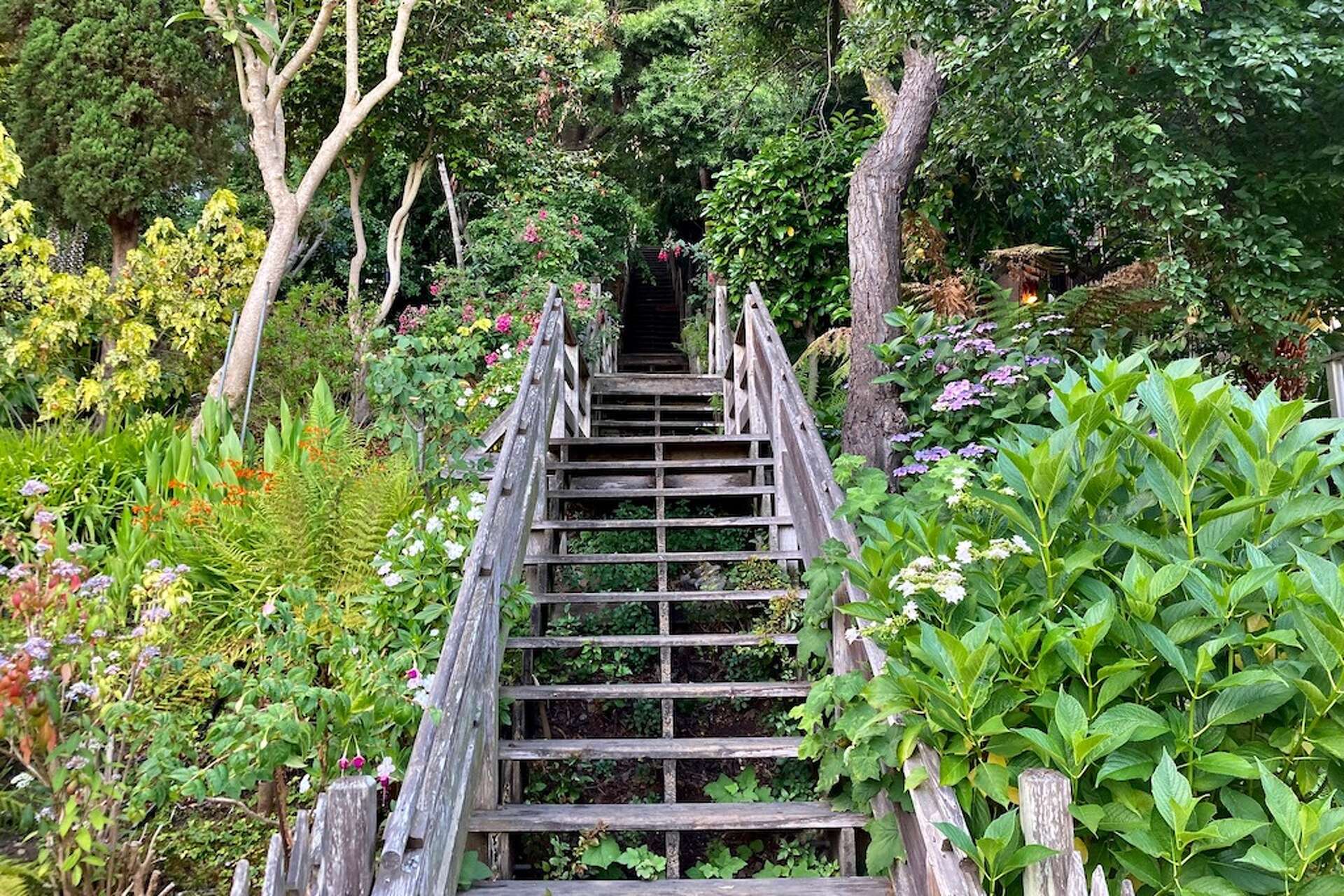
The Filbert Street Steps alone run roughly 400 wooden steps down the hill’s east slope, and several other step streets (Greenwich, Calhoun, Vallejo) are legally streets but physically footpaths (sourced to the Telegraph Hill Dwellers bylaws and SF Planning Code). Homes reached only by these steps have no vehicle access of any kind: no moving truck, no delivery van, no contractor’s pickup can reach the door.
That single fact governs three practical costs most guides skip entirely. Moving companies serving stair-only addresses charge a hand-carry premium, because a crew has to portage furniture up or down the equivalent of several building floors of open-air steps. Contractors bid renovation labor higher for the same reason: materials go up by hand or by a small hoist, not a lift. Grocery and furniture delivery from services expecting curb access often refuses stair-only addresses outright, and residents describe routing large purchases through a downhill address and hand-carrying the last leg.
Do I need a car if I buy on Telegraph Hill? Not for daily errands. Telegraph Hill carries a Walk Score of 97 (Redfin). But if your unit sits on a stair-only block, budget separately for moving, delivery, and renovation costs that assume no vehicle can reach your door.
Boundaries: Three Different Answers to “Where Is Telegraph Hill”
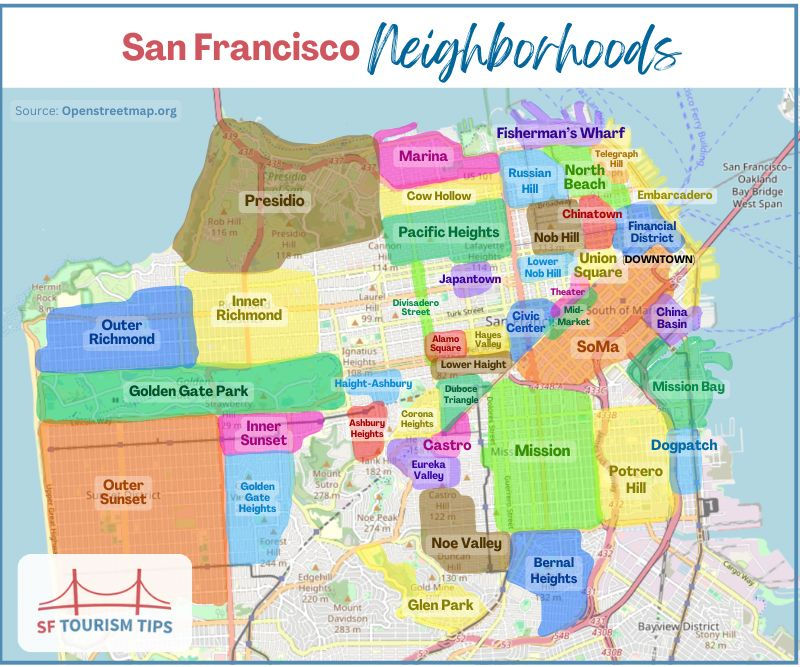
Ask three sources where Telegraph Hill starts and stops, and you get three different maps. The Telegraph Hill Dwellers, the neighborhood’s own association since 1954, define the boundary in their bylaws as starting at Bay and Powell, running south to Columbus, southeast to Broadway, east to the Embarcadero, then north and west back to Powell: a boundary that reaches all the way to the waterfront (Telegraph Hill Dwellers).
The City’s 1986 historic district draws a much tighter line: Greenwich, Sansome, Montgomery, and Green Streets, a six-block core rather than a full neighborhood (SF Planning Code Article 10, Appendix G, via NoeHill).
A third, popular real-estate boundary (Sansome east, Stockton west, Broadway and Francisco as the north-south edges) shows up across brokerage sites, but the sites don’t agree on which street is which edge: one lists Broadway as the northern boundary, while another lists Broadway as the southern one with Francisco to the north, the geographically correct arrangement given Francisco’s proximity to the waterfront (Compass, ApartmentFinder). If a comp your agent pulls sits near Broadway, ask which boundary they’re using before you trust the comp set.
Is Telegraph Hill officially the same thing as North Beach? It depends whose boundary you use. The neighborhood association’s line reaches the Embarcadero and overlaps heavily with North Beach and the northern waterfront; the 1986 historic district covers only a tight six-block core; two brokerage sites even disagree with each other on which street marks the northern edge.
Regulation

Short-term rentals
San Francisco allows short-term rentals only in a host’s primary residence, defined as at least 275 nights of occupancy per year, with unhosted stays capped at 90 nights annually and a $925 application fee (SF Planning, Office of Short-Term Rentals). Crucially for this neighborhood’s ownership mix, the city’s own guidance states that OSTR certification does not override a TIC agreement’s or an HOA’s own subletting restrictions (SF.gov); a unit can be legally registered with the city and still be contractually forbidden from hosting.
Historic and permit review
Property inside the 1986 historic district faces additional design review for exterior work, on top of standard Planning and DBI permitting. Budget extra weeks into any renovation timeline for a building within the Greenwich, Sansome, Montgomery, and Green boundary specifically, since exterior changes there route through a review layer that buildings outside the district skip entirely.
Seismic and structural
San Francisco’s mandatory soft-story retrofit program applies only to wood-frame buildings with 5 or more residential units, 3 or more stories (or 2 over a basement), permitted before January 1, 1978 (SF Department of Building Inspection). Most of Telegraph Hill’s housing stock is smaller, 2 to 4 unit Victorians and Edwardians, which sit outside the mandatory program’s scope by unit count alone. That’s a real exemption, not a safety guarantee: confirm any specific building’s status against DBI’s public soft-story database before assuming it’s covered either way.
Can I legally run a short-term rental on Telegraph Hill? Only if the unit is your primary residence, occupied at least 275 nights a year, with unhosted stays capped at 90 nights. A TIC or HOA agreement can still forbid it even after the city approves your registration.
Are older Telegraph Hill buildings at seismic-retrofit risk? The mandatory program covers wood-frame buildings with 5 or more units and 3 or more stories built before 1978. Most Telegraph Hill buildings are smaller and fall outside that mandatory scope, though owners should confirm status on DBI’s database rather than assume it.
Telegraph Hill vs. North Beach, Russian Hill, and Nob Hill
| Neighborhood | Median sale price | As of / YoY | $/sq ft | As of / YoY |
|---|---|---|---|---|
| Telegraph Hill | $1,200,000 | Mar 2026, -35.7% | $984 | Oct 2025, -23.0% |
| North Beach | $973,000 | Mar 2026, -34.9% | not published | – |
| Russian Hill | $1,924,353 | May 2026, +29.4% | $1,400 | Oct 2025, +24.7% |
| Nob Hill | $1,350,000 | Mar 2026, +12.5% | $962 | Feb 2026, +0.4% |
Source: Redfin neighborhood market pages.
These four adjacent micro-markets moved in opposite directions in the same window: Telegraph Hill and North Beach both fell more than 34 percent year over year on their most recent reported month, while Russian Hill rose nearly 30 percent. A buyer choosing between them on price momentum alone would be comparing four different months, not four comparable snapshots, so weight the direction of travel more than the single headline number.
Who This Neighborhood Suits (and Who It Doesn’t)
A stair-tolerant, car-light owner-occupant who wants a small, historic building and can qualify for fractional financing gets the widest inventory choice and the most negotiating room here. An investor planning nightly short-term rental income should look elsewhere entirely: the primary-residence rule rules out the standard investor model outright. A buyer who needs the broadest lender pool and the fastest resale should weight condo listings over TIC listings even at a price premium, since liquidity is what breaks a sale under time pressure, not the sticker price.
Daily Life and Landmarks

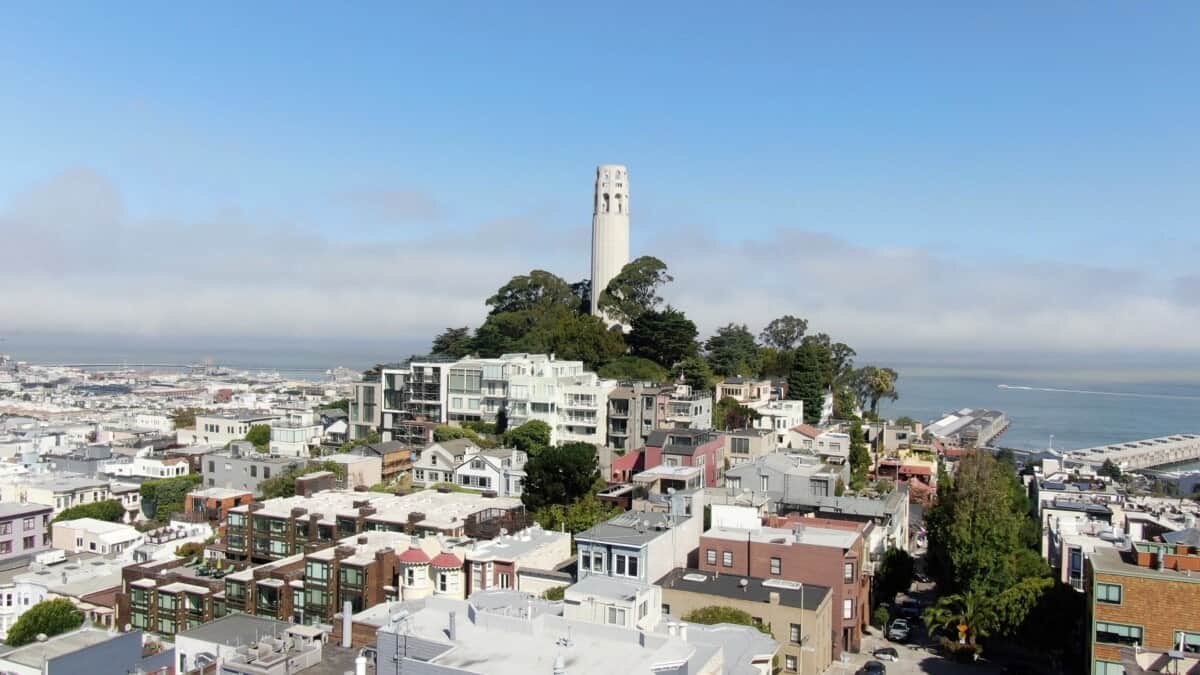
Coit Tower, completed in 1933 on land funded by Lillie Hitchcock Coit’s bequest and designed by Arthur Brown Jr., anchors Pioneer Park at the hill’s summit (SF Recreation and Parks). It was added to the National Register of Historic Places on January 29, 2008 (California State Parks, Office of Historic Preservation). One block of that history is easy to miss on a walk-through: 1360 Montgomery Street’s Malloch Building, built in 1936 in the Streamline Moderne style, sits where Montgomery Street bisects the Filbert Steps and served as the exterior location for the 1947 film noir Dark Passage (NoeHill, sourced to SF Planning Code Article 10, Appendix G).
Comments