
Three legal categories a SoHo loft can fall into

| Category | What governs it | Occupancy rule | Conversion path and cost | Timeline risk |
|---|---|---|---|---|
| Standard condo/co-op, residential CO | NYC Department of Buildings | None beyond building bylaws | None needed | Lowest, standard closing |
| Loft Law unit (Interim Multiple Dwelling) | NYC Loft Board, under Multiple Dwelling Law Article 7-C (court opinion text) | Legalized for residential use under the 1982 Loft Law; occupant need not be an artist | Legalization to a permanent residential CO, separate from the Arts Fund process | Moderate, depends on the building’s legalization stage |
| JLWQA (Joint Living-Work Quarters for Artists) | NYC Department of City Planning, under the 2021 SoHo/NoHo rezoning | Certified artist, or a non-artist grandfathered by the 1986 amnesty or a later successor right | Voluntary conversion to unrestricted residential use, $100 per square foot to the Arts Fund | Highest, fee is currently enforceable but under Supreme Court review |
The distinction matters because the three categories are not interchangeable on paper, even inside a single building: two units on the same floor of the same cast-iron loft building can carry different CO status, different governing bodies, and different costs to occupy legally. Get the certificate of occupancy and the DOB or Loft Board record for the specific unit, not the building.
If I’m not a certified artist, can I still buy a JLWQA loft? Yes, buying is legal, but occupying it long-term as a non-artist generally requires either qualifying under the 1986 amnesty and successor-rights provisions or paying the Arts Fund fee to convert the unit. Pull the specific unit’s certification history before you write an offer, not after.
What the cast-iron architecture buys you, and what it doesn’t guarantee
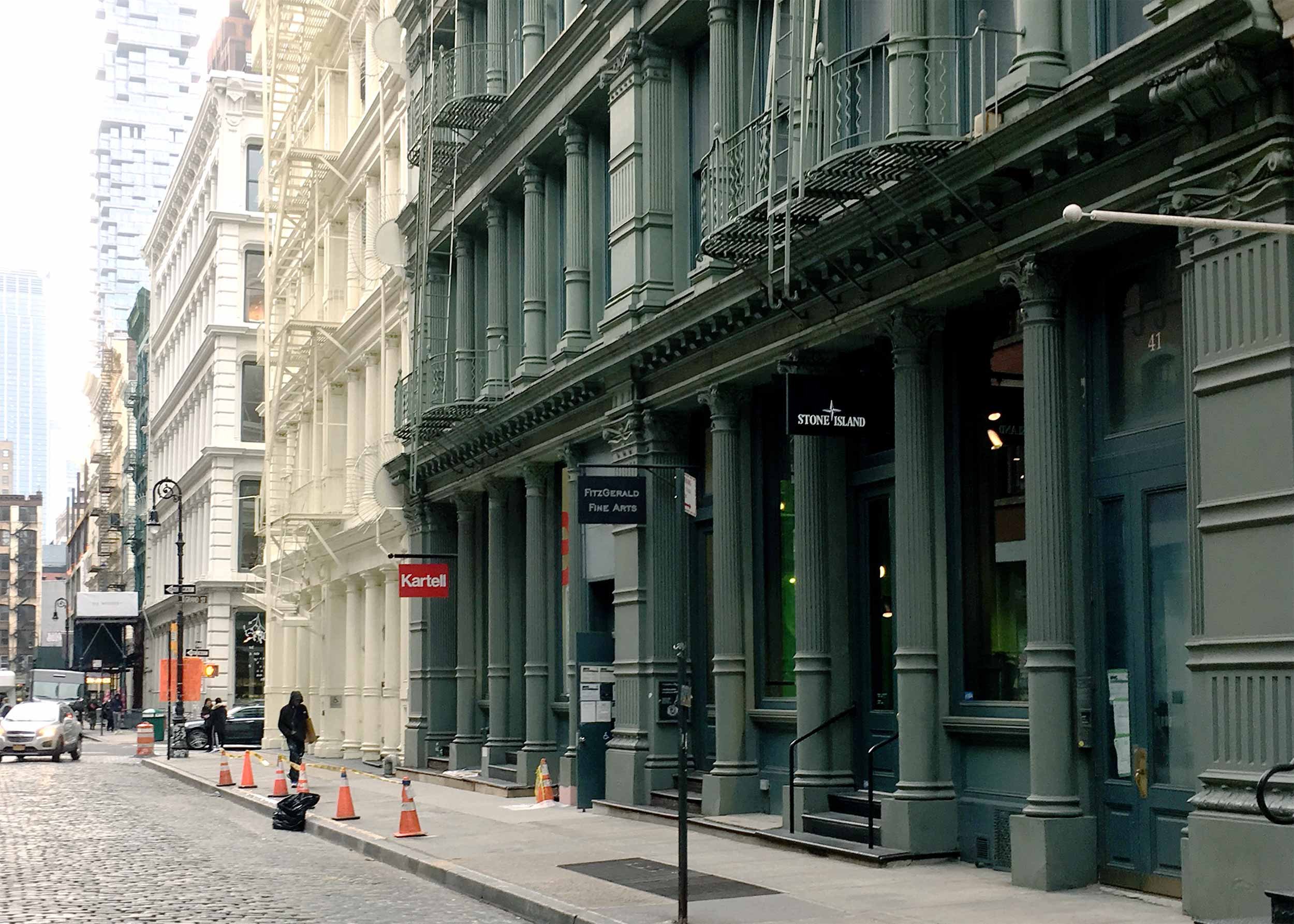
SoHo’s roughly 500 cast-iron buildings were designated the SoHo-Cast Iron Historic District on August 14, 1973 (NYC Landmarks Preservation Commission, 1973 designation report), and the district holds the largest concentration of cast-iron facades anywhere. High ceilings, deep floor plates, and oversized windows are a near-universal feature of the building stock. None of that history changes a unit’s occupancy status: a landmarked, architecturally significant building can still contain an unresolved JLWQA unit.
The Arts Fund fee: what the January 2026 ruling settled, and what’s still pending

On January 13, 2026, New York’s Court of Appeals ruled 6-1 that the $100-per-square-foot Arts Fund fee does not violate the Fifth Amendment’s takings clause, reversing a lower appellate court that had struck the fee down (Justia; Bloomberg Law). Judge Jenny Rivera, writing for the majority, held that a standalone monetary payment is not a taking because it does not force the transfer of a property interest; Judge Michael Garcia dissented. For an average SoHo loft, industry estimates put the fee near $250,000 (Pacific Legal Foundation).
That is not the end of the story. Pacific Legal Foundation has since filed a petition asking the U.S. Supreme Court to review the case, arguing the ruling conflicts with the Court’s 2013 decision in Koontz v. St. Johns River Water Management District and with a contrary reading adopted by North Carolina’s high court (Pacific Legal Foundation). Court of Appeals Judge Anne Halligan, who joined the majority, wrote separately that the dissent’s constitutional argument “may well eventually prevail” (amNewYork). Buyers weighing a JLWQA purchase today are paying under law that a sitting appellate judge has flagged as vulnerable. The fee is enforceable now. Budget for it as if it will stay that way, and check current status before closing.
Zigi Ben-Haim, an 80-year-old artist who has lived in his SoHo loft since 1979, is now weighing what to do about a fee attached to selling or passing the unit to his family, a concrete illustration of who actually carries this cost (amNewYork).
Does the Arts Fund fee still apply while the Supreme Court petition is pending? Yes. The January 2026 ruling is controlling law unless and until the Supreme Court grants review and rules otherwise. Sellers, buyers, and lenders should treat the fee as currently enforceable.
Financing and insurance: the friction lenders don’t publish

A unit without a permanent residential Certificate of Occupancy, whether a Temporary CO or one still pending Loft Law legalization, is harder to finance and insure than a standard condo, because appraisers have fewer directly comparable closed sales to point to and lenders vary in how they treat legal-use uncertainty. No major lender publishes a standardized public policy on this. Get your loan officer’s specific position on the unit’s CO status in writing before you go under contract, not after. The same logic applies to homeowner’s or master-policy insurance on a mixed-use or landmarked building: ask what the master policy actually covers and where its coverage stops, rather than assuming it mirrors a standard condominium policy.
Does a Temporary Certificate of Occupancy block financing? It doesn’t automatically block it, but it narrows the pool of lenders willing to underwrite the loan and can extend the appraisal and underwriting timeline. Get the lender’s position on the specific CO status in writing during your financing contingency period.
Co-op board realities in loft buildings

Board packages in SoHo loft co-ops carry the standard expectations: proprietary lease and bylaws, recent board minutes, audited financials, flip-tax terms, sublet policy. What differs in a loft building is the paperwork’s origin. A proprietary lease may still be written for artist-era occupancy, so read the lease and house rules for language that predates the building’s current residential reality rather than checking only the current financial statements. This is building-specific, with no published aggregate data; request the documents directly.
What’s different about co-op board approval in a loft building versus a standard prewar co-op? The approval process itself is usually similar. The documents differ: request the proprietary lease’s original occupancy language and any amendments tied to JLWQA or Loft Law status, since a standard co-op checklist wouldn’t flag those.
Renovation: LPC tiers, timelines, and cost ranges
Because most SoHo lofts sit inside the historic district, exterior work, facades, windows, storefronts, rooftop equipment visible from the street, needs Landmarks Preservation Commission approval before the Department of Buildings will issue a permit. The LPC reviews roughly 12,000 to 13,000 applications a year, and about 95% are resolved at the staff level rather than at a public hearing (NYC.gov LPC).
| Approval tier | Triggers it | Review body | Minimum published timeline |
|---|---|---|---|
| Certificate of No Effect | Work doesn’t change the protected exterior | LPC staff | 30 business days or more (NYC.gov) |
| Permit for Minor Work | Work affects a protected feature but needs no DOB permit | LPC staff | 20 business days or more (RAND PC) |
| Certificate of Appropriateness | Major exterior alteration | Full Commission, public hearing | No statutory minimum; adds 2 to 4 months beyond DOB filing (Havard Cooper) |
Landmark review only reaches the exterior and street-visible elements; ordinary interior work generally bypasses LPC and goes straight to your co-op or condo board and the DOB. Professional and regulatory fees typically add 15% to 25% on top of raw construction cost in a landmarked building (Havard Cooper), and general full-apartment renovation costs across NYC run $250 to $600-plus per square foot depending on finish level (Hello Chapter). No SoHo-specific cost dataset is published, so treat the low end of that range as optimistic for a landmarked cast-iron unit with unmodernized mechanical systems.
How long does LPC review take for interior work that isn’t visible from the street? Interior work generally doesn’t require LPC review at all, only work visible from a public way triggers the process. Confirm this with your architect against your specific scope, since visibility can include rear facades depending on sightlines.
SoHo vs. Tribeca: price, inventory, and who each fits
| SoHo | Tribeca | |
|---|---|---|
| Median sale price | $2.8M | $3.8M |
| Price per square foot | $2,313 | $2,024 |
| Homes sold in the reporting period | 17 | 28 |
| Source and period | PropertyShark, April 2026 | PropertyShark, January 2026 |
Both figures come from the same data provider, so the comparison is apples to apples, but the sample sizes, 17 and 28 closed sales, are small enough that a handful of large or small transactions can swing the median by double digits month to month. Tribeca’s per-square-foot figure sits below SoHo’s in this snapshot despite Tribeca’s higher median price, which reflects Tribeca’s larger average unit size rather than a lower cost basis. SoHo suits a buyer prioritizing walkable retail and gallery density and willing to accept smaller floor plates; Tribeca suits a buyer prioritizing larger full-floor layouts and a quieter residential streetscape, generally at a higher total price.
For investors: yield and the conversion-cost math
If you’re buying a JLWQA unit as a rental investment rather than to occupy, the Arts Fund fee changes the return calculation directly: a $100-per-square-foot, roughly $250,000 conversion cost on an average unit has to be underwritten against rental income, not folded quietly into a renovation budget. One brokerage estimate puts SoHo loft rental yields in the 2.5% to 3.5% range annually (DecodeNYC, a single brokerage’s market observation rather than a verified dataset). Sublet restrictions in co-op buildings can also limit whether a JLWQA-to-residential conversion is even useful for a rental strategy, since some co-op boards cap the number of units that can be sublet at any time, a building-specific fact to confirm with the board rather than assume from the offering plan alone.
Does the Arts Fund fee apply if I’m buying a unit that’s already been converted to residential use? No, the fee attaches to the act of converting a JLWQA unit. A unit that has already completed conversion and carries a standard residential CO isn’t subject to it again at resale.
Red flags and a pre-offer due-diligence checklist
- CO status mismatch. The unit’s certificate of occupancy doesn’t match its actual use. This is the single most consequential thing to verify before you write an offer.
- Open DOB violations or stop-work history. Pull the Buildings Information System record for the specific address; an open violation can delay both financing and any renovation permit.
- Unregistered Loft Law status. If the unit is claimed as an IMD, confirm its registration and legalization stage directly with the NYC Loft Board rather than taking the seller’s word for it.
- Board documents that still reflect artist-era occupancy language. Read the proprietary lease and bylaws for restrictions tied to JLWQA or Loft Law status that a standard co-op package wouldn’t surface.
- No written lender position on CO status. Get your loan officer’s specific underwriting position on the unit before your financing contingency expires.
- LPC job history gaps. Request the building’s LPC permit history for any pending or open applications that could affect your renovation plans.
Comments