
What “East Tremont” Actually Covers
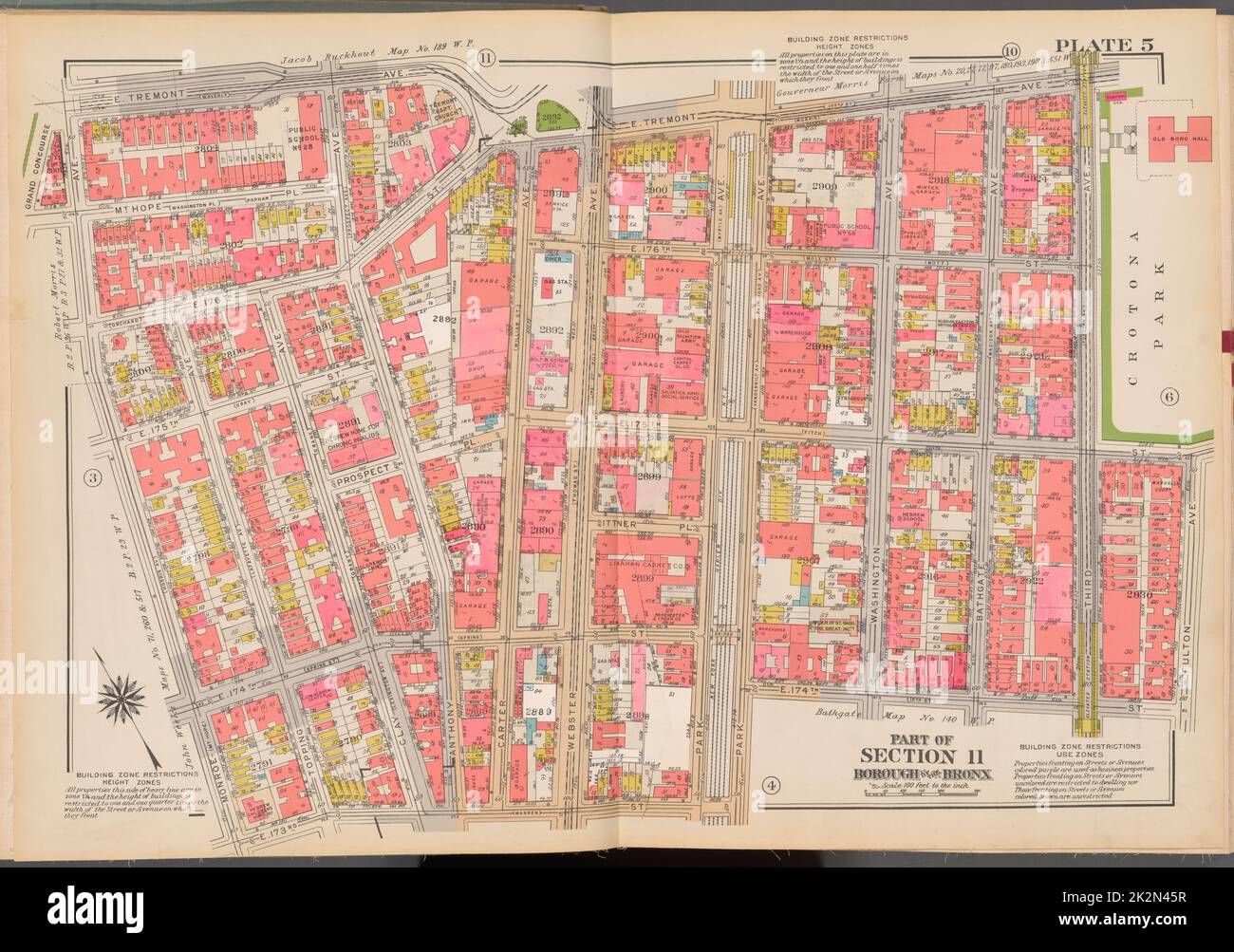
The NYPD’s 48th Precinct, which polices East Tremont, also covers Belmont and West Farms, bounded roughly by the Cross Bronx Expressway and Crotona Park to the south. Real-estate data providers don’t always draw the neighborhood line the same way the precinct does, which is one reason a “median price for East Tremont” pulled from one dataset can differ from another: they aren’t always describing the same footprint.
Is East Tremont Avenue the same as the East Tremont neighborhood? No. The avenue continues through Belmont, Van Nest, and Westchester Square. A listing search built on the street name alone pulls in inventory well outside the East Tremont neighborhood.
The Housing Stock: Ownership Types and Their Constraints
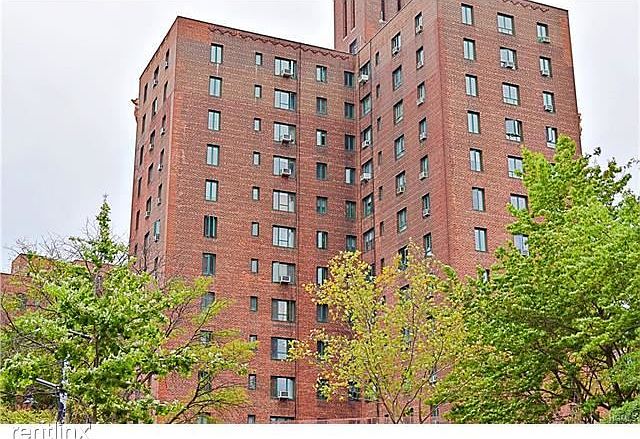
HDFC co-ops: income caps, resale limits, board risk
Housing Development Fund Corporation co-ops are city-created affordable cooperatives, and their income ceiling is a hard filter, not a soft guideline. New York’s 2026 Area Median Income is $152,700 for a three-person household at 100% AMI, per NYC HPD. HDFC buildings can set their income cap anywhere up to 165% of that figure, and many set it lower, commonly at 120%. A household can qualify at one HDFC building and be rejected at another two blocks away, with no appeal: these caps apply strictly at the point of purchase, per HPD’s own cooperative shareholder fact sheet.
Two constraints matter more than the price tag. Subletting is generally limited to no more than 18 months within any 5-year period. Nearly every HDFC sale carries a flip tax that splits resale profit between the seller and the building. Board approval also screens for income eligibility, not just creditworthiness, a different rejection risk than a standard co-op board presents.
| Property type | Bronx-wide sale median (proxy, not East Tremont-specific) | Key ownership constraint | Financing difficulty |
|---|---|---|---|
| HDFC co-op | Not separately broken out in the borough-wide dataset used here | Income capped at 120% to 165% of AMI at purchase; resale price and subletting restricted | High: fewer lenders write HDFC loans, larger down payments typical |
| Standard (non-HDFC) co-op | $215,000 | Board approval, no income cap | Moderate |
| Single-family house | $727,000 | None beyond standard title and zoning review | Lower |
| Condominium | $325,000 | None beyond standard title and HOA rules | Lower to moderate |
The blank HDFC cell is deliberate. The Bronx-wide figures above come from recorded closed sales; no verifiable, non-portal source in this research broke that figure out by HDFC status for East Tremont specifically. Pricing an HDFC unit here means pulling the building’s own regulatory agreement and resale formula, not applying a neighborhood average.
Can I get a mortgage on an HDFC co-op here? Some banks decline HDFC lending outright because resale caps complicate collateral valuation. Identify a lender who already finances HDFC purchases before making an offer, not after.
Rental buildings and rent-stabilization exposure
Rent stabilization generally applies to buildings with six or more units built between February 1, 1947 and January 1, 1974, per the NYC Rent Guidelines Board. An investor underwriting rent growth on a multi-family building in this corridor needs the construction year and unit count before assuming market-rate increases are available; inside that window, annual increases are set by the Rent Guidelines Board, not the owner. Close to half of all NYC rental units carry this status citywide, so treating a given East Tremont rental building as unregulated by default is the wrong starting assumption.
Price Reality: What the Numbers Actually Measure
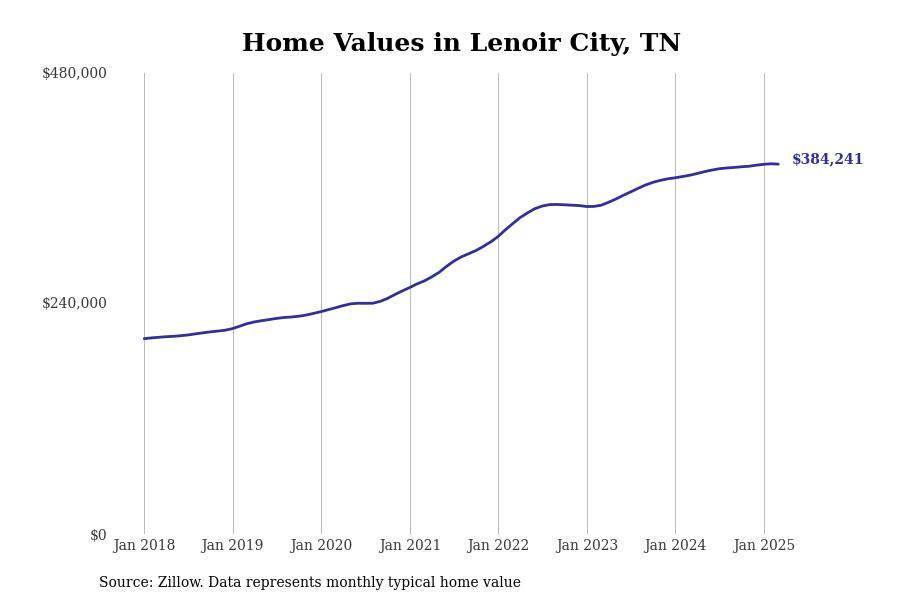
Every East Tremont price figure circulating online measures something different, and the clearest proof doesn’t require comparing different companies. Zillow’s East Tremont neighborhood page lists a Zillow Home Value Index of $424,375. Two separate Zillow borough-wide pages, checked the same week, give Bronx County averages of $442,754 (down 12.3% year over year) and $484,833 (up 4.2% year over year): a roughly $42,000 gap between two pages from the same provider.
For actual closed-sale data, the closest verifiable, non-competitor source found here is borough-wide: recorded Bronx sales from April 2025 through March 2026 show a co-op median of $215,000, a single-family median of $727,000, and a condo median of $325,000, drawn from New York City Department of Finance property records, filtered to remove nominal and non-arms-length transfers.
| Source | Reported figure | Date / period | Scope | Likely reason for the gap |
|---|---|---|---|---|
| Zillow ZHVI, East Tremont page | $424,375 | Current, as indexed 2026 | Neighborhood-level model estimate | Statistical index, not a closed-sale median |
| Zillow ZHVI, Bronx County page A | $442,754 (down 12.3% year over year) | Current | County-wide model estimate | Different index snapshot than page B |
| Zillow ZHVI, Bronx County page B | $484,833 (up 4.2% year over year) | Current | County-wide model estimate | Different index snapshot than page A |
| NYC DOF recorded sales, via brokerage analysis | Co-op $215,000 / house $727,000 / condo $325,000 | April 2025 to March 2026 | Borough-wide, by property type | Real closed sales, not filtered to East Tremont |
None of these four rows should be quoted to a client as “the East Tremont median.” A tighter figure exists only at the census-tract level inside NYC’s own ACRIS sales database, filtered to the relevant property type, and that pull comes before an offer, not a portal headline.
Transit and the Commute Burden as a Demand Signal
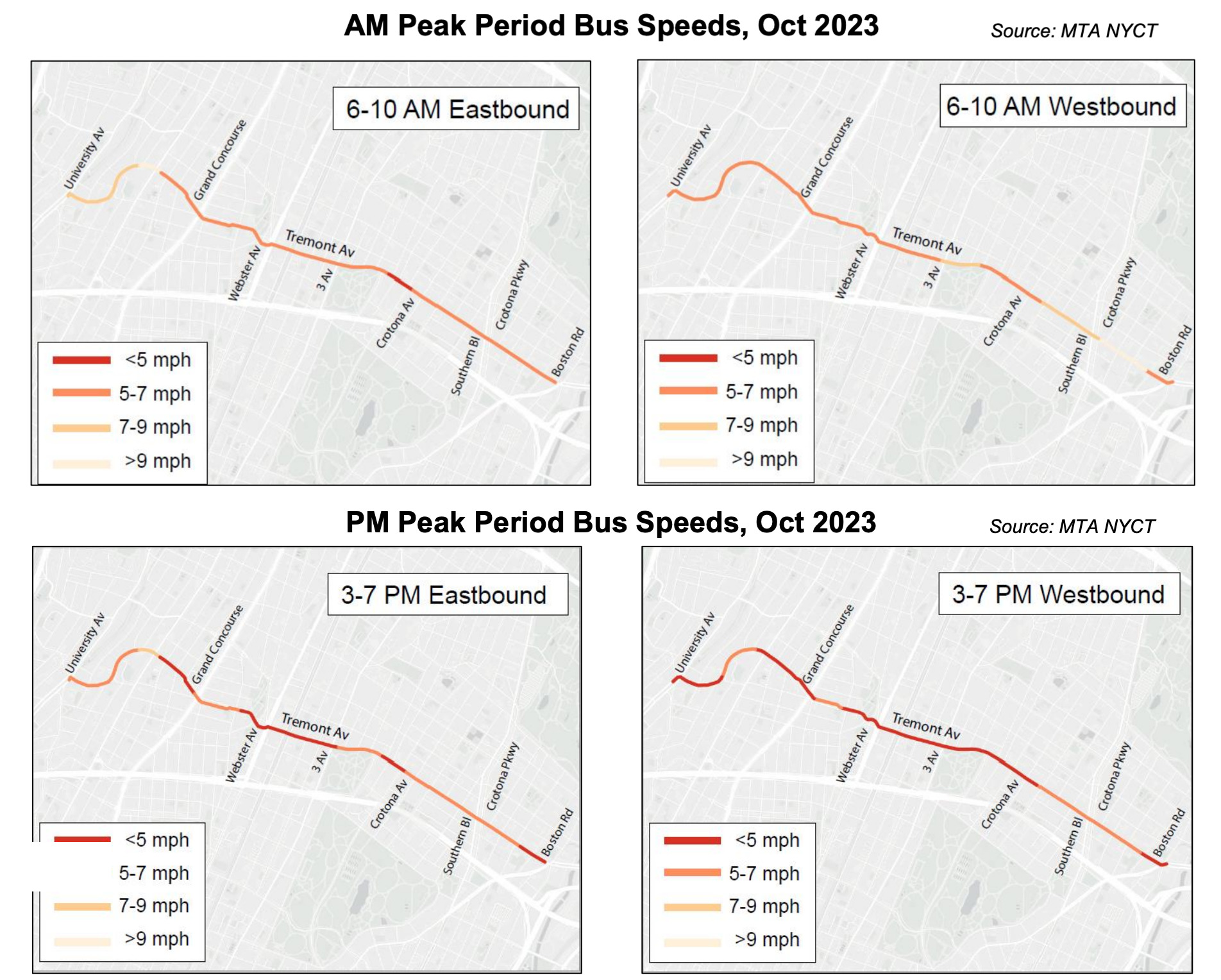
The corridor’s Metro-North stop, Tremont station on the Harlem Line, is not a high-frequency option: trains run every 30 minutes at peak and roughly hourly off-peak, and the station itself is not wheelchair accessible, per the MTA, with the nearest accessible stops at Fordham and Harlem–125th Street. That fact runs against the common “excellent transit access” framing seen in most write-ups of this corridor. The honest read: the subway and bus network is the corridor’s real trunk service, with Metro-North a limited supplement rather than a primary commute option.
| Mode | Line / route | Nearest stop to the corridor | What it actually offers |
|---|---|---|---|
| Subway | 4, B, D | 174–175 Sts | The corridor’s real day-to-day trunk service |
| Metro-North (Harlem Line) | Tremont station | East Tremont Ave at Park Ave | 30-minute peak headway, hourly off-peak; not wheelchair accessible |
| Local bus | Bx36, Bx40, Bx41, Bx41-SBS, Bx42 | Clustered at the Tremont station | Feeds both the subway and Metro-North; no one-seat ride to Midtown |
Is this a rent-stabilized market? To check a specific building rather than the neighborhood as a whole, request its rent history through NYS Homes and Community Renewal’s rent-history lookup; the building’s registration record, not its listing description, is the authoritative answer.
Crime and Schools Along the Corridor
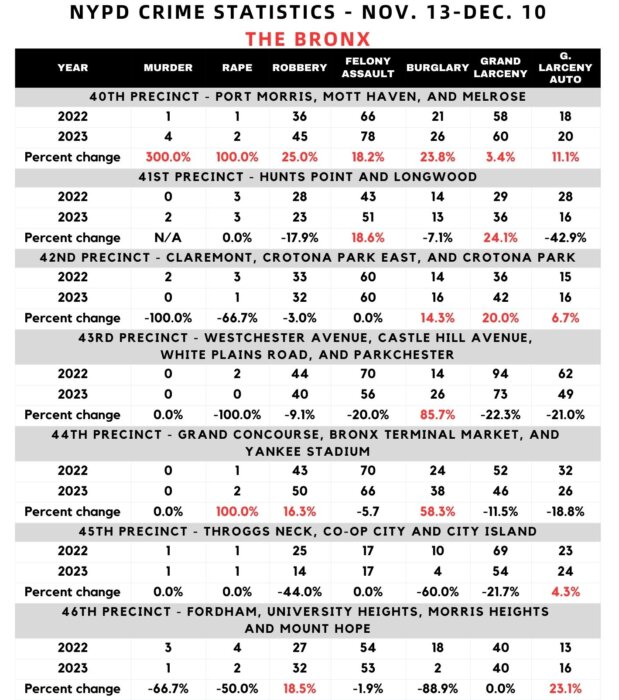
The 48th Precinct, commanded by Deputy Inspector Andrew Lombardo, covers East Tremont, Belmont, and West Farms, with Fordham University’s Bronx campus sitting in the precinct’s northern corner. Its year-to-date 2026 CompStat report shows 1 murder against 9 over the same period in 2025, an 88.9% drop. Robbery complaints fell 31.2% (108 vs. 157) and felony assault fell 19.1% (228 vs. 282) over the same comparison window. Burglary moved the other direction, up 16.8% (118 vs. 101), and grand larceny rose 3.8% (246 vs. 237).
A buyer comparing this corridor to a generic “crime score” widget should ask which specific complaint categories that score blends together, since this precinct’s categories are not all moving in the same direction.
School-zoning data tied to specific East Tremont addresses, sourced independently of real-estate portals, wasn’t obtained in this research pass. The New York City Department of Education’s own zoning finder, checked against the exact address in question, is the accurate substitute for a borrowed rating pulled from a generic neighborhood profile.
Common Mistakes Buyers and Investors Make Here
- Treating the avenue and the neighborhood as interchangeable. Listings and news mentioning “East Tremont Avenue” may sit in a different neighborhood entirely.
- Assuming HDFC income caps are negotiable. They are fixed at the point of purchase, per building, and boards do not grant exceptions for buyers slightly over the limit.
- Skipping the rent-stabilization check on a multi-family purchase. Confirming construction year and unit count first avoids modeling rent increases the Rent Guidelines Board won’t allow.
- Quoting one portal’s median price to a client. Two pages from the same provider can disagree by tens of thousands of dollars, as shown above.
Who This Corridor Suits, and Who It Doesn’t
An owner-occupant who qualifies under a specific HDFC building’s income cap gets a real below-market entry point into Bronx homeownership, in exchange for capped resale upside and a flip tax on the way out. An investor targeting a multi-family building needs the construction year in hand before modeling any rent increase, since roughly half of this corridor’s older rental stock is a rent-stabilization candidate. A buyer wanting unrestricted resale flexibility and faster appreciation should look at the corridor’s non-HDFC co-op and condo stock instead, where the Bronx-wide medians above apply without an income filter.
Is East Tremont a good place to invest right now? That depends on which of the four numbers in the price table above you’d be buying against, and whether the specific building carries HDFC or rent-stabilization status. Pull the building-level facts first.
Comments