
What A-Mill Artist Lofts Is, in Facts

A-Mill Artist Lofts occupies the former Pillsbury “A” Mill at 315 SE Main Street in Minneapolis, a National Historic Landmark built in 1881 for flour magnate Charles Pillsbury. The building is income-restricted housing built specifically for practicing artists, not open-market housing with an artsy theme: residency requires both a household-income qualification and a separate review confirming the applicant is an active artist.
The 2013 to 2015 renovation, led by developer Dominium, converted the mill’s original grain-handling spaces into 251 apartment homes plus dedicated studios; the building filled to capacity within months of its 2015 opening.
Income Limits and the Rent Math That Decides Eligibility

The property publishes maximum household income limits based on the number of occupants, tied to the federal Low-Income Housing Tax Credit program and the Area Median Income for the Twin Cities.
| Household size | Maximum annual income | Minimum annual income to qualify (2.5x a $1,250 rent) |
|---|---|---|
| 1 | $55,620 | $37,500 |
| 2 | $63,600 | $37,500 |
| 4 | $79,440 | $37,500 |
| 8 | $104,880 | $37,500 |
Source: A-Mill Artist Lofts affordable housing page. The minimum-income column applies the property’s stated 2.5x-rent rule to the top of the historical rent band; a household renting a lower-priced unit needs proportionally less. A one-person household earning $37,500 clears both the income floor and the income ceiling for every household size shown; a four-person household at the same income also qualifies, since the ceiling rises with occupancy while the floor is set by the rent itself, not by household size.
Do I need income from my art to qualify?No. The property’s own qualification criteria state that creating the work does not have to be the applicant’s income source; at least one household member must show a demonstrated commitment to an art form, which the artist committee evaluates separately from the income screening.
The published income figures are worth double-checking before you budget a move: A-Mill’s own homepage and its dedicated affordable-housing page list slightly different ceilings for the same household sizes, likely reflecting the annual HUD update landing between two site refreshes rather than two different rules.
The Two-Part Application: Housing Screening and the Artist Committee

Qualifying involves two separate reviews that run on different criteria:
- Income and household screening. Third-party verification of all income sources, including wages, Social Security, and public assistance, plus tax returns and pay stubs. Housing vouchers from local authorities are accepted.
- Artist committee review. A submitted resume, references, a portfolio, a history of creative work, and stated long-term creative goals, reviewed by a committee of artists rather than leasing staff. Qualifying practice spans visual, craft, performance, media, and design disciplines, so the bar is breadth of active practice rather than a specific medium.
Full processing, from application to decision, averages 7 to 10 business days once a unit is available, per the property’s own listing page.
Can my income later go above the limit and still keep my unit?Yes. Once a household initially qualifies, its income can exceed the maximum limits afterward and residency continues; full-time student status restrictions, by contrast, remain in force for the life of the tenancy.
Unit Sizes, Finishes, and What’s Inside a Loft
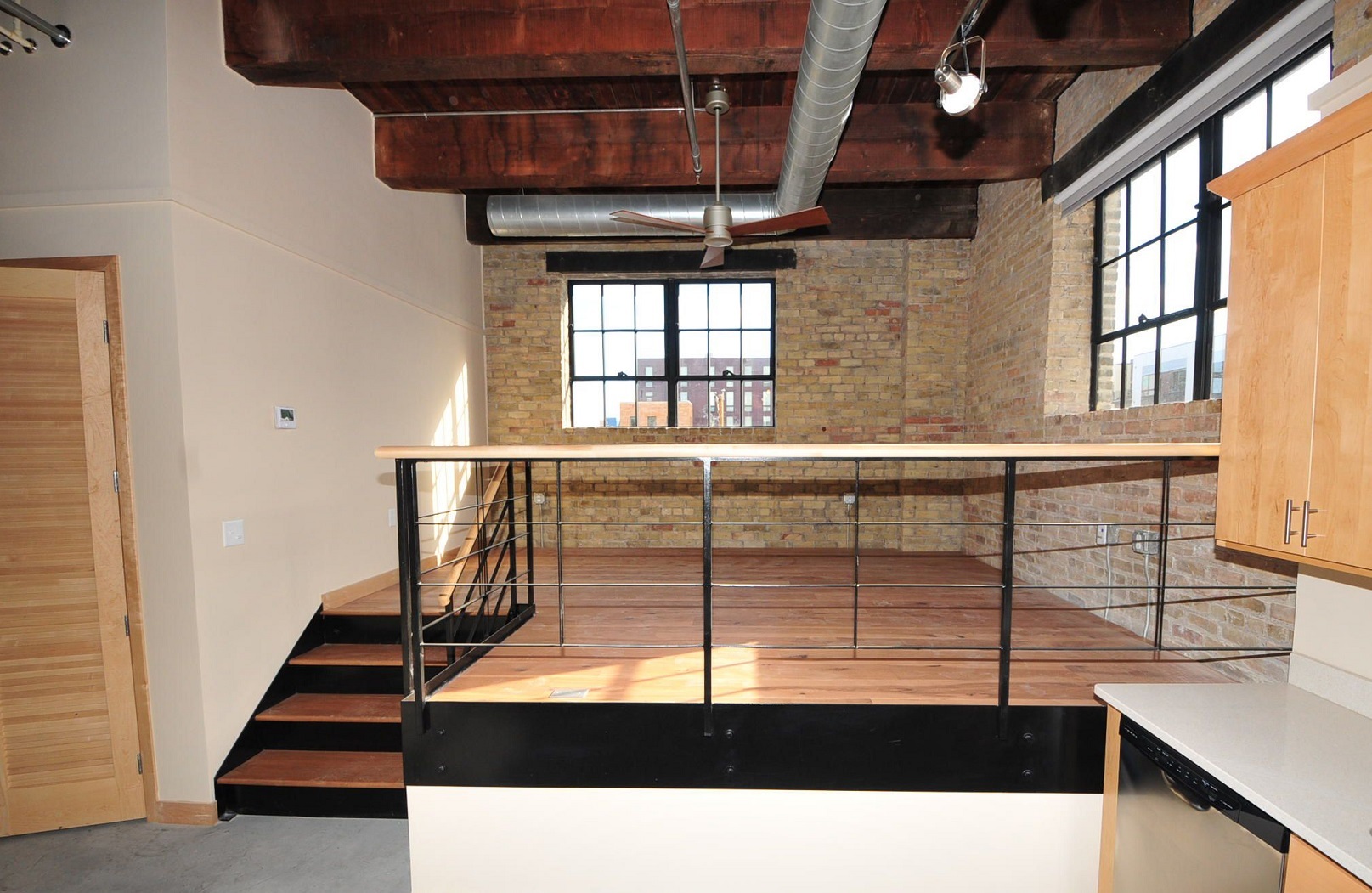
Layouts range from studios of roughly 600 to 757 square feet up to four-bedroom units approaching 2,081 square feet. Ceilings run 10 to 14 feet, a legacy of the mill’s original grain-handling floors, paired with sealed concrete flooring, skylights in select units, and in-unit washer and dryer sets. Heating and cooling run on a hydro-thermal system, and kitchens use Energy Star appliances.
Shared Studios and Artist Infrastructure
- Dedicated practice studios: separate painting, pottery, photography, and music spaces, distinct from a general fitness room.
- A performance and rehearsal center: for movement, dance, and music practice beyond what a home studio allows.
- An on-site gallery: for showing finished work to other residents and visitors.
- A rooftop clubroom and deck: river and skyline views, used as informal gathering space rather than a private amenity.
From Vacant Flour Mill to LEED Gold Landmark

| Milestone | Detail | Source |
|---|---|---|
| 1881 | Built for Charles Pillsbury; largest, most advanced flour mill in the world at 4,000 barrels/day capacity | National Trust for Historic Preservation |
| Vacant from 2003 | Sat empty roughly eight years before a preservation-risk listing | National Trust for Historic Preservation |
| 2011 | Named to the National Trust’s 11 Most Endangered Places list | National Trust for Historic Preservation |
| 2013 to 2015 | Dominium renovation; building opened and filled to capacity within months | National Trust for Historic Preservation |
| Present | 251 units, LEED Gold certified; on-site hydroelectric generation covers more than 70% of peak power needs | BKV Group |
A luxury-condominium conversion of the same building was attempted and abandoned before Dominium’s affordable-housing plan moved forward in 2013, one reason the mill sat vacant as long as it did.
This history explains a detail invisible from the marketing copy: the building’s hydroelectric system, fed by the same Mississippi River drop that once powered the flour mill, now supplies most of its own peak electricity, running less on the municipal grid than a typical apartment building its size.
A-Mill vs. Schmidt Artist Lofts: Dominium’s Twin Communities

Dominium operates a second, larger income-restricted artist community 8 miles away in St. Paul, useful context if A-Mill’s waitlist is closed.
| A-Mill Artist Lofts | Schmidt Artist Lofts | |
|---|---|---|
| Former use | 1881 Pillsbury flour mill | 1930s Jacob Schmidt Brewery |
| Housing units | 251 | 247 lofts plus 13 townhomes |
| Opened as housing | 2015 | 2013 to 2014 |
| Bedroom types | Studio through 4-bedroom | 1, 2, and 3-bedroom, no studio |
| Distinct shared space | Performance/rehearsal center, on-site gallery | Dedicated dance/movement studio, sound and music studio |
Source: BKV Group, National Trust for Historic Preservation, Dominium. Both properties draw on the same Twin Cities income-limit table, so an applicant who qualifies financially for one generally qualifies for the other; the deciding factor becomes bedroom count and which waitlist is shorter at the time of application.
Who Manages the Building

A-Mill Artist Lofts is owned and managed by Dominium, a Plymouth, Minnesota-based affordable housing developer. Beyond A-Mill and Schmidt, Dominium also operates Metropolitan Artist Lofts in St. Louis, Missouri, giving the company a specific track record in artist-focused, income-restricted housing rather than general market-rate management.
Is A-Mill Artist Lofts pet-friendly?Yes, up to two pets per apartment, cats and dogs both permitted, with breed restrictions possible and a DNA-based waste-matching program required for dogs.
What Residents Actually Say, and Mistakes That Sink Applications

Resident feedback splits along a consistent line. Positive reviews cite the historic character, the walkable riverfront location near the Stone Arch Bridge, and, in several cases, a responsive management team. Critical reviews cluster around slow maintenance turnaround, unresolved noise complaints between units, and rising rents at renewal; one recurring criticism argues that AMI-based “affordable” rent still runs high given the surrounding neighborhood’s market rates, a fair point given that AMI reflects the whole metro area’s income, not the immediate block.

Common reasons otherwise income-qualified applicants get rejected or delayed:
- Treating the artist review as a formality. A thin portfolio or a resume with no documented creative history is a common rejection reason, since the committee evaluates the same materials as a residency panel would.
- Assuming any household member can join later. If every original qualifying member vacates, the remaining or incoming household must re-qualify from scratch, not simply inherit the lease.
- Missing the full-time-student rule. A household made up entirely of full-time students does not qualify for tax-credit housing regardless of income or artistic merit, unless a recognized exemption applies.
What happens if everyone in my original household moves out?New occupants must meet the full initial qualifying criteria from scratch; the unit’s tax-credit eligibility doesn’t carry over automatically with a lease transfer.
Comments